The Hidden Architecture of Roots: How Plants Engineer Soil
Published on December 31, 2025 by Admin
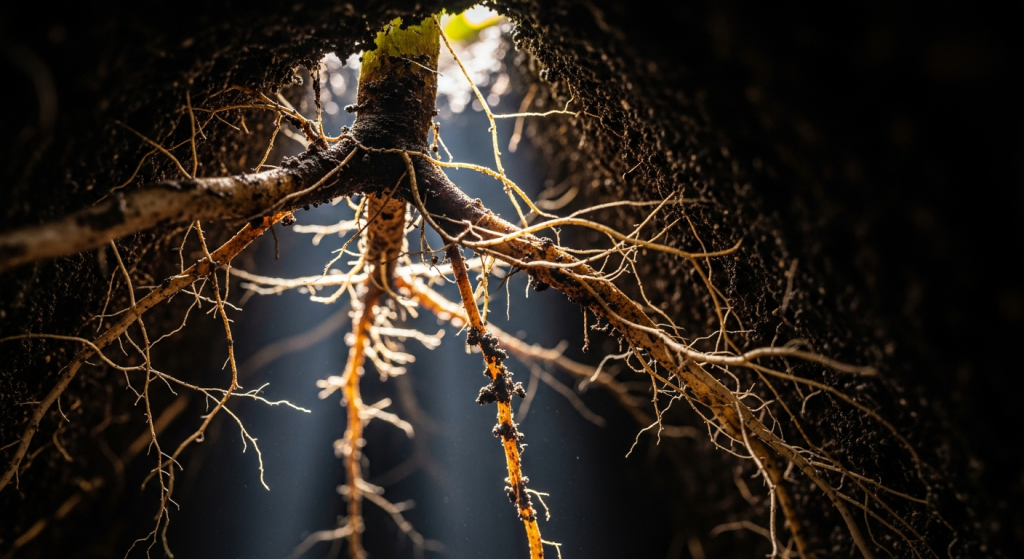
Beneath our feet lies a hidden world. This is the realm of plant roots. They are far more than simple anchors. Roots actively shape and engineer the soil. Their intricate structures and functions are vital for plant survival. They also profoundly impact ecosystem health. Understanding this hidden architecture is key for civil engineers and plant biologists alike.

Unveiling the Root System: More Than Meets the Eye
For too long, our understanding of roots was limited. Many early illustrations were based on guesswork. However, pioneers like John Weaver changed this. Weaver meticulously studied prairie plants and vegetables. He revealed just how extensive root systems can be. His research showed that assumptions about root depth are often wrong. For instance, horseradish can grow roots 13-14 feet deep. Yet, it might only grow 4-5 feet tall above ground. Conversely, some trees are tall but have shallow root systems. Therefore, above-ground height does not indicate root width.
This work highlights a crucial point. The foliage of a plant does not dictate the extent of its root system. Roots can spread much farther than we might assume. This is especially true for water and nutrient acquisition. The oldest roots, near the trunk, develop bark. This bark prevents nutrient absorption. Instead, nutrient uptake occurs through root hairs. These are microscopic growths on lateral roots. These lateral roots extend from the main or lead roots.
The Drip Line Myth and Root Expansion
A common gardening tip suggests fertilizing near the drip line. This is the area under the edge of a plant’s canopy. The idea is that roots end here. However, this is often not true. Roots frequently grow far beyond the drip line. Tomatoes, for example, are known to have roots that extend horizontally much further than their foliage suggests. As trees mature, their root systems expand. Therefore, it is important to adjust watering and fertilization strategies over time. For young trees, drip emitters should be moved farther from the trunk as the roots grow.
Soil Type Dictates Root Behavior
The type of soil significantly influences root growth patterns. This knowledge is crucial for effective water, mulch, and fertilizer placement. In compacted, heavy clay soil, roots tend to grow closer to the surface. They seek out more aerobic zones. These areas have better oxygen levels for growth. Consequently, roots may not spread as widely as the plant’s foliage. In clay soils, 90% or more of the roots can be found in the top foot. As much as 10-30% might be in the top 4 inches. The topsoil is the most critical layer because it is the most aerobic. More oxygen in the soil aids soil biota. This biota converts minerals into soluble nutrients. Roots then absorb these nutrients.
Tree roots often struggle in clay soil. When they encounter it, they tend to grow sideways. This is a strategy to avoid dense, low-oxygen conditions. Therefore, understanding soil composition is fundamental for both agricultural and civil engineering projects. Soil stabilization and water management strategies must account for root behavior influenced by soil type.
The Science of Abscisic Acid in Root Development
Plant roots are not just passive structures. They actively respond to their environment. This response is guided by genetic programs. A key player in this process is Abscisic Acid (ABA). ABA is a plant hormone. It plays a critical role in modulating root growth. It helps plants adapt to changes in their local environment. For instance, ABA is involved in root responses to drought. It can influence root elongation and branching. This hormonal regulation is essential for plants to thrive in diverse conditions.
The hormone Abscisic Acid acts as a hidden architect of root system structure. This intricate hormonal control ensures roots can effectively seek out resources. It also helps them navigate challenging soil conditions.
Root Architecture: Engineering for Survival and Soil Health
Roots perform several critical functions. They anchor the plant. They absorb water and nutrients. Furthermore, they play a significant role in soil engineering. Roots create channels in the soil. This improves aeration and water infiltration. Their presence also enhances soil structure. This is particularly important in areas prone to erosion. The complex network of roots binds soil particles together. This binding action significantly reduces soil loss. This is a vital consideration for civil engineers designing infrastructure in natural landscapes.
The mass and distribution of roots contribute to soil stability. Root systems can increase the spatial coverage of a given soil volume. This is achieved through the proliferation of fine roots. These fine roots are highly efficient at exploring the soil matrix. Therefore, understanding root architecture is crucial for predicting soil behavior under various loads and environmental conditions. The intricate network of plant roots extends deep into the earth, revealing nature’s hidden architecture.
Taproots vs. Fibrous Roots: Diverse Strategies
Not all root systems are the same. Plants employ diverse strategies. Oak trees, pine trees, and persimmons often have taproots. A taproot is a large, central, and dominant root. It grows straight down into the soil. It serves as a primary anchor. It also efficiently accesses deep water sources. However, fewer than 5% of trees actually have a true taproot system. Most trees rely on other structures to stay upright and obtain resources.
In contrast, many plants have fibrous root systems. These systems consist of many thin, branching roots. They spread out horizontally. This provides excellent soil binding capabilities. It also allows for efficient nutrient and water absorption from the upper soil layers. The choice between a taproot or fibrous system often depends on the plant’s native environment and its specific needs.
Advanced Techniques for Studying Roots
Studying root systems in their natural soil environment presents challenges. Traditional methods often involve destructive excavation. However, modern technologies offer non-invasive solutions. X-ray microcomputed tomography (μCT) is a powerful tool. It allows for detailed visualization of root systems within the soil. This technique is invaluable for researchers. It provides insights into root architecture and distribution. However, variations in X-ray attenuation can make distinguishing roots from soil difficult.
Researchers have developed automated methods to overcome these challenges. Software can view μCT data as a sequence of images. This allows for the tracking of root objects. Such advancements are crucial for understanding plant-microbe interactions. They also aid in engineering drought-resistant crops and environmental remediation efforts. The assessment of root distribution in soils remains a critical area of research.
Despite the critical importance of roots within soils for supporting plant growth, the assessment of root distribution in soils remains a complex task.
Furthermore, researchers are developing new chip designs. These chips analyze plant-microbe interactions. Such innovations are vital for advancing our understanding of underground ecosystems. They also support the development of sustainable agricultural practices. The hidden life of roots and their interactions with microbes are central to soil health.
Plant root-microbe interactions (RMI) are hidden beneath the soil.
Roots and Soil Biota: A Symbiotic Relationship
Roots do not exist in isolation. They are part of a complex soil ecosystem. This ecosystem includes a vast array of microorganisms. Bacteria, fungi, and other microbes live in close association with roots. This association is often symbiotic. Plants provide sugars and other organic compounds to microbes. In return, microbes help plants access nutrients. For example, mycorrhizal fungi form intricate networks. These networks connect plant roots. They facilitate nutrient and water exchange. This underground internet is crucial for plant health. It also contributes to overall soil structure and function.
The health of the soil microbiome is directly linked to plant vitality. A thriving soil biome can improve nutrient availability. It can also enhance disease resistance in plants. Understanding these relationships is essential for sustainable agriculture and ecological restoration. The interconnectedness of roots and soil microbes is a testament to nature’s efficiency.
The Hidden Universe: Soil Microbes Powering Our Planet
Implications for Civil Engineering and Environmental Management
The engineering capabilities of roots have significant implications for civil engineers. Root systems can stabilize slopes. They can prevent soil erosion. This is particularly important in road construction and land development. In some cases, carefully managed vegetation can reduce the need for extensive artificial stabilization structures. However, roots can also pose challenges. They can damage infrastructure like pipes and foundations. Therefore, understanding root growth patterns and their potential impact is crucial during the planning and construction phases of projects.
Moreover, the role of roots in soil remediation is increasingly recognized. Certain plants can absorb and break down pollutants in the soil. This process, known as phytoremediation, offers a sustainable approach to cleaning up contaminated sites. By understanding how roots interact with soil and contaminants, we can develop more effective strategies for environmental management. This is a key aspect of regenerative agriculture, which aims to heal the earth through farming practices.
Frequently Asked Questions
How deep do plant roots typically grow?
Root depth varies greatly by plant species and soil conditions. For example, horseradish roots can grow 13-14 feet deep, while some trees have much shallower root systems. In heavy clay soils, roots tend to stay closer to the surface.
What is the drip line and its significance for roots?
The drip line is the area under the edge of a plant’s canopy. While water often lands here, roots frequently extend far beyond this zone to seek water and nutrients.
How do roots engineer the soil?
Roots bind soil particles together, which helps prevent erosion. They also create channels that improve soil aeration and water infiltration, enhancing soil structure.
What are root hairs and why are they important?
Root hairs are microscopic outgrowths from root tips. They significantly increase the surface area of roots, making them highly efficient at absorbing water and dissolved nutrients from the soil.
Can root systems damage infrastructure?
Yes, root systems can damage infrastructure such as pipes and foundations by growing into them or exerting pressure. Understanding root behavior is important in urban planning and construction.
Conclusion: The Unsung Architects of Our World
The hidden architecture of plant roots is truly remarkable. These subterranean structures are not passive elements. They are dynamic engineers of the soil. They influence soil structure, water cycles, and nutrient availability. For civil engineers, understanding root systems is vital for stable construction. For plant biologists, it’s key to unlocking plant potential. As we continue to explore this hidden world, our appreciation for the intricate engineering of plants grows. This knowledge empowers us to better manage our landscapes and foster healthier ecosystems.