
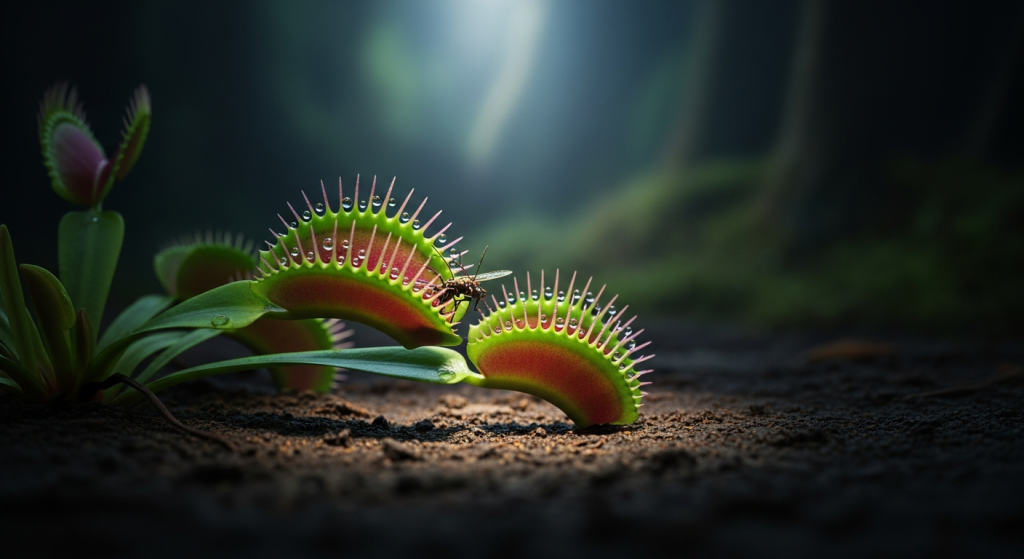
Carnivorous plants are truly fascinating. They have evolved unique ways to survive. Many thrive in environments where other plants struggle. These plants capture and digest insects and other small creatures. This adaptation helps them get nutrients. It allows them to flourish in nutrient-poor soils. Let’s explore the magic of these remarkable plants.
The Allure of Insectivorous Flora
Carnivorous plants possess an almost supernatural allure. Their very existence challenges our perception of plant life. They are not passive organisms. Instead, they actively hunt. This predatory behavior sets them apart. Many species have adapted to harsh conditions. These include nutrient-poor bogs and sandy soils. The natural world presents many strange plants. Some even resemble body parts or have eerie names. For example, the bleeding heart plant looks like a dripping heart. Cockscomb flowers can have a brain-like appearance. Japanese blood grass gets its name from its red spikes. Witches’ hair, also known as dodder, is a parasitic plant that feeds on others. These examples highlight nature’s diverse and sometimes unsettling creativity.
Adapting to Survive: The Need for Carnivory
The primary driver behind carnivory in plants is nutrient deficiency. Many carnivorous plants grow in bogs and wetlands. These environments are often acidic. They also lack essential nutrients like nitrogen and phosphorus. Normal plants would struggle to survive here. However, carnivorous plants have developed remarkable adaptations. They supplement their diet by trapping and digesting prey. This strategy allows them to thrive where others cannot. For instance, the Butterwort (Pinguicula vulgaris) uses sticky glandular hairs on its leaves. These hairs ensnare insects attracted by sweet nectar. The plant then secretes enzymes to digest its prey. This process provides the vital nutrients missing from its boggy habitat. Similarly, Sundews (Drosera spp.) also use sticky tentacles to trap insects. These plants are found in damp, nutrient-poor environments.
Mechanisms of Capture and Digestion
Carnivorous plants employ a variety of ingenious traps. These mechanisms are highly specialized. They have evolved to lure, capture, and digest their prey effectively. These adaptations are crucial for their survival and reproduction.
Pitfall Traps: The Pitcher Plants
Pitcher plants, such as Sarracenia species, use a pitfall trap. Their leaves are modified into deep, pitcher-shaped structures. These pitchers are often brightly colored. They also produce nectar to attract insects. Inside the pitcher, the walls are slippery. They may also have downward-pointing hairs. This design makes it difficult for insects to escape. Once an insect falls into the pitcher, it drowns in a pool of digestive fluid. Enzymes in the fluid then break down the prey. This nutrient-rich broth is absorbed by the plant. The Sarracenia genus, also known as trumpet pitchers, showcases this deadly beauty in their natural habitat. These special adaptations ensure that captured prey rarely escapes. Once the struggle ends, insects are digested, and their nutrient-rich broth is absorbed.
A cluster of Sarracenia x moorei pitcher plants stands tall in a misty…
Snap Traps: The Iconic Venus Flytrap
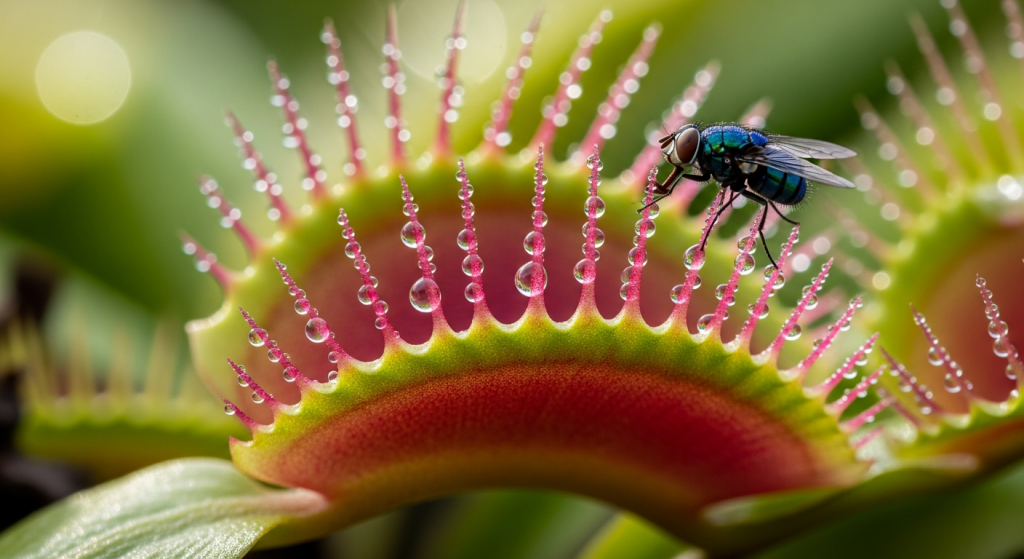
The Venus flytrap (Dionaea muscipula) is perhaps the most famous carnivorous plant. It uses a dramatic snap trap. Its leaves are fringed with stiff hairs. These hairs act as triggers. When an insect touches two or more trigger hairs in quick succession, the trap snaps shut. This rapid closure effectively captures the prey. Digestive enzymes are then secreted. They break down the insect, providing nutrients. The mechanism is remarkably precise. It avoids closing on non-food items like raindrops.
Flypaper Traps: Sundews and Butterworts
Sundews (Drosera spp.) and Butterworts (Pinguicula spp.) employ a flypaper trap. Their leaves are covered in glands. These glands secrete a sticky mucilage. Insects are attracted to the glistening dew-like droplets. When they land, they become stuck. The tentacles or leaf margins then slowly curl inwards. This action brings more sticky glands into contact with the prey. Digestion occurs through enzymes secreted by specialized glands. The Round-Leaved Sundew (Drosera rotundifolia) and Spatulate-leaved Sundew (Drosera intermedia) are examples. They are found in the Scottish Highlands and use this method.
Deadly Beauty: The Carnivores that Bloom in the Bog
Bladder Traps: Utricularia’s Submerged Hunters
Bladderworts (Utricularia spp.) are fascinating aquatic or terrestrial carnivorous plants. They use tiny, bladder-like traps. These bladders have a trapdoor. Tiny aquatic organisms or soil invertebrates trigger the door. The bladder rapidly expands, creating a vacuum. This sucks water and prey into the trap. Once inside, the prey is digested. This method is highly effective in waterlogged or very wet soils.
Habitat and Distribution
Carnivorous plants have a global distribution. However, they are most commonly found in specific habitats. These habitats share similar environmental conditions. Understanding these environments is key to appreciating their unique adaptations.
Bogs and Wetlands: The Classic Carnivorous Home
Bogs and wetlands are prime habitats for many carnivorous plants. These environments are characterized by waterlogged, acidic soils. They are also notoriously low in essential nutrients. The high water content prevents oxygen from reaching plant roots. This further limits nutrient availability. Plants like Sundews, Butterworts, and Pitcher plants thrive here. They have evolved to overcome these challenges. For example, the Scottish Highlands boast extensive peatlands. These are crucial habitats for carnivorous flora.
The importance of preserving the Highland Bogs for plantlife
Sandy Plains and Epiphytic Niches
Some carnivorous plants also inhabit sandy plains. These areas may be well-drained but nutrient-poor. Venus flytraps, for instance, are native to the coastal plains of North and South Carolina. Here, they grow in sandy, acidic soils. Other species have adapted to grow as epiphytes. They grow on other plants, like trees, without rooting in the soil. This allows them to access sunlight in dense environments. Some tropical pitcher plants (Nepenthes) can be epiphytic. This showcases their remarkable adaptability to diverse environments.
Cultivating Carnivorous Plants
For exotic plant collectors, growing carnivorous plants is a rewarding hobby. However, it requires specific knowledge. Mimicking their natural habitat is crucial for success. Special care is needed for watering, soil, and feeding.
The Importance of Water and Soil
Carnivorous plants need pure water. Tap water often contains minerals. These minerals can harm sensitive carnivorous plants. Distilled water, reverse osmosis water, or rainwater are ideal. Using the wrong water can be detrimental. The soil must also be nutrient-poor. A common mix is peat moss and perlite or sand. This combination mimics bog conditions. It provides drainage without adding unwanted nutrients. For example, Venus flytrap seed kits and Sarracenia seeds are available for enthusiasts to grow their own.
Seed And Seed Kits | South West Carnivorous Plants
Feeding Your Insectivorous Friends
Carnivorous plants catch their own food. However, indoor plants may need supplemental feeding. Small insects like flies, gnats, or mealworms are suitable. Avoid feeding them large prey. It can overwhelm and rot the trap. Do not feed them human food. This can also cause harm. Overfeeding can be as detrimental as underfeeding. A few insects every few weeks are usually sufficient.
Evolutionary Significance
The evolution of carnivory in plants is a testament to natural selection. It demonstrates how organisms adapt to extreme conditions. These plants offer valuable insights into plant evolution. They also highlight the biodiversity of our planet. Their unique survival strategies are a marvel of biological engineering.
A Window into Plant Evolution
Carnivorous plants represent a significant evolutionary leap. They developed complex mechanisms for prey capture and digestion. This occurred independently in several plant lineages. This is known as convergent evolution. It shows how similar environmental pressures can lead to similar adaptations. Studying them helps biologists understand evolutionary pathways. It also sheds light on the development of complex traits. The variety of traps seen across different species is remarkable. This diversity reflects different evolutionary histories. It also shows how they have adapted to varied ecological niches.
Conservation Concerns
Many carnivorous plant species face threats. Habitat destruction is a major concern. Drainage of wetlands and pollution impact their populations. Invasive species can also outcompete native carnivorous plants. Protecting their natural habitats is vital for their survival. Conservation efforts are underway to safeguard these unique plants. For instance, common butterwort has become scarce in many areas due to land drainage.
Frequently Asked Questions
What makes carnivorous plants “carnivorous”?
Carnivorous plants are defined by their ability to attract, capture, and digest small animals, primarily insects. They do this to obtain essential nutrients that are lacking in their native soil environments.
Do I need to feed my carnivorous plants manually?
Generally, no. If grown outdoors or in an environment with access to insects, they will catch their own food. For indoor plants, occasional feeding with small insects can be beneficial but is not always necessary. Overfeeding can be harmful.
What kind of water should I use for carnivorous plants?
It is crucial to use pure water. Tap water often contains minerals that can build up in the soil and harm carnivorous plants. Use distilled water, reverse osmosis water, or clean rainwater.
Are all carnivorous plants dangerous?
While they are predators of insects, carnivorous plants are generally harmless to humans and larger animals. Their traps are designed for small prey. Some plants, like Belladonna, are toxic but not carnivorous.
Where do carnivorous plants typically grow?
They are most commonly found in nutrient-poor environments such as bogs, fens, and wetlands. Some species also inhabit sandy plains or grow as epiphytes in tropical rainforests.
Conclusion
Carnivorous plants are extraordinary examples of adaptation. Their unique hunting strategies and specialized habitats make them endlessly fascinating. From the dramatic snap of a Venus flytrap to the passive allure of a pitcher plant, these plants showcase nature’s ingenuity. For collectors and biologists alike, understanding their magic offers a deeper appreciation for the diversity of life on Earth. Their continued existence depends on our efforts to preserve their delicate ecosystems.
