
Permaculture: Your Self-Sustaining Home Ecosystem
Published on January 13, 2026 by Admin
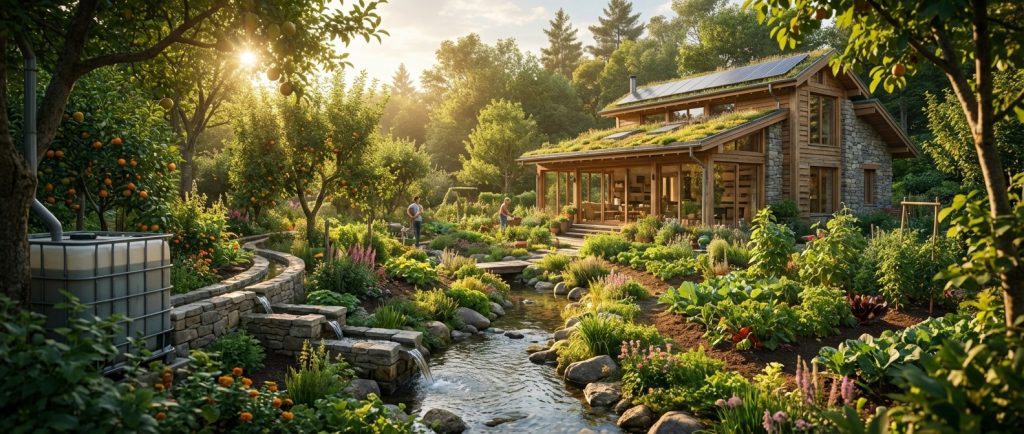
Imagine a home that works with nature, not against it. A place that produces its own food, manages its own waste, and thrives with minimal external input. This is the promise of permaculture systems. It’s a design philosophy for creating self-sustaining domestic ecosystems. Therefore, it offers a path towards ecological resilience and personal autonomy.
Permaculture is more than just gardening. It’s a holistic approach to living. It integrates land, resources, and people. The goal is to create systems that are productive and regenerative. They mimic the patterns found in natural ecosystems. This article explores the core principles and practical applications of permaculture for homeowners and landscape designers.
The Pillars of Permaculture Design
At its heart, permaculture is guided by three core ethics. These ethics inform all design decisions. Firstly, there’s care for the Earth. This means valuing biodiversity and natural resources. Secondly, care for people is essential. It focuses on meeting human needs sustainably. Lastly, fair share is crucial. This principle encourages reinvesting surplus back into the system and community.
These ethics are then translated into design principles. These principles provide a framework for creating effective permaculture systems. They are observational and practical. They encourage working with nature rather than against it. For instance, observing your site’s microclimates is key. This helps you place elements where they will thrive best.
Key Permaculture Principles Explained
- Observe and Interact: Understand your site’s unique conditions. Look at sun, wind, water flow, and existing life.
- Catch and Store Energy: Design systems to capture resources when they are abundant. This includes sunlight, water, and biomass.
- Obtain a Yield: Ensure your system produces useful outputs. This could be food, fiber, or energy.
- Apply Self-Regulation and Accept Feedback: Monitor your system’s performance. Make adjustments as needed based on observations.
- Use and Value Renewable Resources and Services: Prioritize natural and renewable inputs. Minimize reliance on finite resources.
- Produce No Waste: Design systems where all outputs become inputs for another process. This creates closed-loop systems.
- Design from Patterns to Details: Start with broad patterns. Then, fill in the specific details.
- Integrate Rather Than Segregate: Place elements so they support each other. This builds synergistic relationships.
- Use Small and Slow Solutions: Opt for manageable systems that are easier to maintain and adapt.
- Use and Value Diversity: A diversity of elements increases resilience. It also provides a wider range of functions.
- Use Edges and Value the Marginal: The interface between different elements is often the most productive.
- Creatively Use and Respond to Change: Be adaptable. Embrace changes as opportunities for improvement.
Applying these principles leads to more resilient and productive landscapes. For example, integrating a pond with surrounding plantings creates a microclimate. It also provides habitat and water storage.
Zone Planning: Optimizing Your Space
A fundamental concept in permaculture is “zone planning.” This involves dividing your land into zones based on how frequently you access and manage them. This strategy optimizes energy use and effort. It places elements requiring the most attention closest to the home.
Understanding the Zones
- Zone 0: The Home: This is your dwelling. Design it to be energy-efficient and connected to the surrounding landscape.
- Zone 1: Daily Use Areas: Located immediately around the home. This is where you’ll find herb gardens, salad greens, and frequently used tools. You visit this zone multiple times a day.
- Zone 2: Less Frequent Use: Areas for less frequently harvested crops, small animals like chickens, and composting. You visit this zone daily or every few days.
- Zone 3: Main Crops and Pasture: This zone is for larger crops, orchards, and larger livestock. It requires less frequent attention.
- Zone 4: Semi-Wild Area: Managed for foraging, timber, or wildcrafting. This area requires minimal intervention.
- Zone 5: Wilderness: An unmanaged area left for nature. It serves as a reference and a source of biodiversity.
By carefully placing elements within these zones, you reduce unnecessary work. For instance, having your kitchen garden in Zone 1 means less travel time for harvesting ingredients. This is a direct application of the “small and slow solutions” principle.
Water Management in Permaculture
Water is a precious resource. Permaculture design prioritizes its efficient use and conservation. This involves techniques to capture, store, and infiltrate water effectively. Consequently, it reduces reliance on municipal water sources and mitigates drought impacts.
Key Water Harvesting Strategies
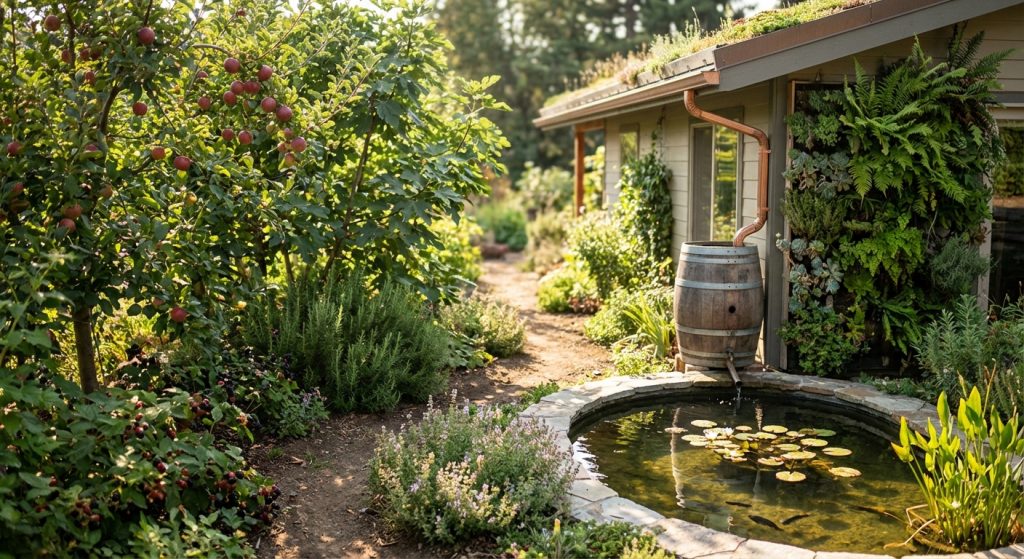
- Rainwater Harvesting: Collecting rainwater from rooftops into tanks or cisterns. This provides a source for irrigation and household use.
- Swales: Long, shallow ditches dug on contour. They capture and slow down rainwater runoff. This allows it to soak into the soil, hydrating the landscape and preventing erosion.
- Ponds and Dams: Creating water bodies to store significant amounts of water. These also create microclimates and habitats.
- Keyline Design: A method for managing water on slopes. It involves a series of contours that guide water to where it is most needed.
Effective water management is crucial for building resilience. For example, swales can transform dry, sloped land into a lush, productive area. This is a powerful example of working with natural water flows.
Soil Health: The Foundation of Life
Healthy soil is the bedrock of any thriving ecosystem. Permaculture emphasizes building and maintaining soil fertility through natural processes. This approach avoids synthetic fertilizers and pesticides. Instead, it focuses on nurturing the soil food web.
The soil is a living entity. It teems with microorganisms, fungi, and invertebrates. These organisms break down organic matter. They also make nutrients available to plants. Thus, fostering this underground universe is paramount. You can learn more about the hidden universe of soil microbes and their role.
Building Fertile Soil
- Composting: Turning kitchen scraps and garden waste into nutrient-rich compost. This is a fundamental way to recycle organic matter.
- Cover Cropping: Planting specific crops to protect and improve soil. They prevent erosion, add organic matter, and fix nitrogen.
- Mulching: Covering the soil surface with organic materials. This retains moisture, suppresses weeds, and feeds soil organisms.
- No-Till Gardening: Avoiding plowing or excessive digging. This preserves soil structure and the delicate soil ecosystem.
- Animal Integration: Using livestock like chickens or worms to aerate soil and provide manure.
Regenerative agriculture practices, which are closely aligned with permaculture, focus on healing the earth. They emphasize practices that improve soil health over time. This directly contributes to a self-sustaining system.
Biodiversity and Companion Planting
Diversity is a hallmark of natural ecosystems. Permaculture actively seeks to increase biodiversity in domestic landscapes. This creates a more resilient and productive environment. It also attracts beneficial insects and wildlife.
Companion planting is a key strategy. It involves planting different species together. They benefit each other in various ways. For instance, some plants repel pests. Others attract pollinators. Some may even improve the soil for their neighbors. This integration is vital for a balanced ecosystem.
Consider the symbiotic relationship between pollinators and plants. This natural partnership is essential for fruit and seed production. By creating habitats for pollinators, you enhance the yield of your garden. Furthermore, understanding plant communication networks can offer insights into creating more harmonious garden ecosystems. You can explore how plants communicate.
Creating Self-Sustaining Food Systems
A primary goal of permaculture is food security. This means designing systems that provide a consistent and diverse food supply. It involves integrating various edible plants and potentially small-scale animal husbandry.
Edible Landscaping and Food Forests
Edible landscaping transforms ornamental spaces into productive food-producing areas. This involves incorporating fruit trees, berry bushes, and edible perennials into your design. Food forests are a prime example. They mimic natural forest structures. They feature multiple layers of edible plants, from canopy trees to groundcovers and root crops.
For example, a food forest might include:
- Canopy Layer: Large fruit or nut trees (e.g., apples, walnuts).
- Understory Layer: Smaller fruit trees or large shrubs (e.g., dwarf fruit trees, elderberries).
- Shrub Layer: Berry bushes (e.g., blueberries, raspberries).
- Herbaceous Layer: Perennial vegetables and herbs (e.g., rhubarb, mint, strawberries).
- Groundcover Layer: Edible groundcovers (e.g., creeping thyme, clover).
- Root Layer: Root vegetables (e.g., Jerusalem artichokes, potatoes).
- Vertical Layer: Climbing plants (e.g., grapes, passionfruit).
This layered approach maximizes space and productivity. It also creates a resilient system that requires less maintenance over time. This is a direct application of designing from patterns to details.
Waste Management: Closing the Loop
Permaculture aims for a “zero waste” system. This means all outputs from one element become inputs for another. This creates a closed-loop system where waste is minimized and repurposed.
Composting is a cornerstone of permaculture waste management. Kitchen scraps, yard trimmings, and animal manure can all be composted. The resulting compost then nourishes the soil. This reduces the need for external fertilizers. Furthermore, greywater systems can be integrated to reuse water from sinks and showers for irrigation. This is a clever way to conserve water resources.
Integrating Animals into the System
Small-scale animal integration can significantly enhance a permaculture system. Animals can provide valuable services. These include pest control, fertilization, and even tilling. For example, chickens can help manage insect populations in orchards. They also provide manure for compost. Worm farms, or vermicomposting, efficiently convert food scraps into nutrient-rich fertilizer.
However, it is essential to manage animals responsibly. This aligns with the principle of care for people and the Earth. It ensures their well-being and minimizes any negative environmental impact. Understanding animal instincts and herd dynamics is also important for effective management.
Frequently Asked Questions (FAQ)
What is the main goal of permaculture?
The main goal of permaculture is to create sustainable human settlements and agricultural systems. These systems mimic the relationships found in natural ecosystems. They aim for self-sufficiency and ecological regeneration.
Is permaculture only for rural areas?
No, permaculture principles can be applied anywhere. This includes urban environments. Techniques like urban permaculture, vertical farming, and container gardening allow for sustainable food production in cities. You can even create productive urban green spaces. Look into the ecology of urban green spaces for more ideas.
How long does it take to establish a permaculture system?
The timeline varies greatly. Initial observation and planning can take time. However, you can start implementing small, slow solutions immediately. Some elements, like perennial plants and trees, take years to mature. Yet, you can see yields and benefits much sooner.
Do I need a large garden for permaculture?
Not necessarily. Permaculture is about smart design, not just size. Even a small balcony or backyard can be transformed using permaculture principles. Techniques like square-foot gardening and vertical gardening are highly effective in limited spaces.
Conclusion: Designing for a Resilient Future
Permaculture systems offer a powerful framework for building self-sustaining domestic ecosystems. By embracing its ethics and principles, practitioners and designers can create landscapes that are not only productive but also regenerative. They contribute to ecological health and personal resilience.
Implementing permaculture is a journey. It requires observation, adaptation, and a willingness to work with nature’s inherent intelligence. As we face increasing environmental challenges, adopting permaculture practices becomes more vital than ever. It empowers us to create a more sustainable and harmonious future, one ecosystem at a time.
