
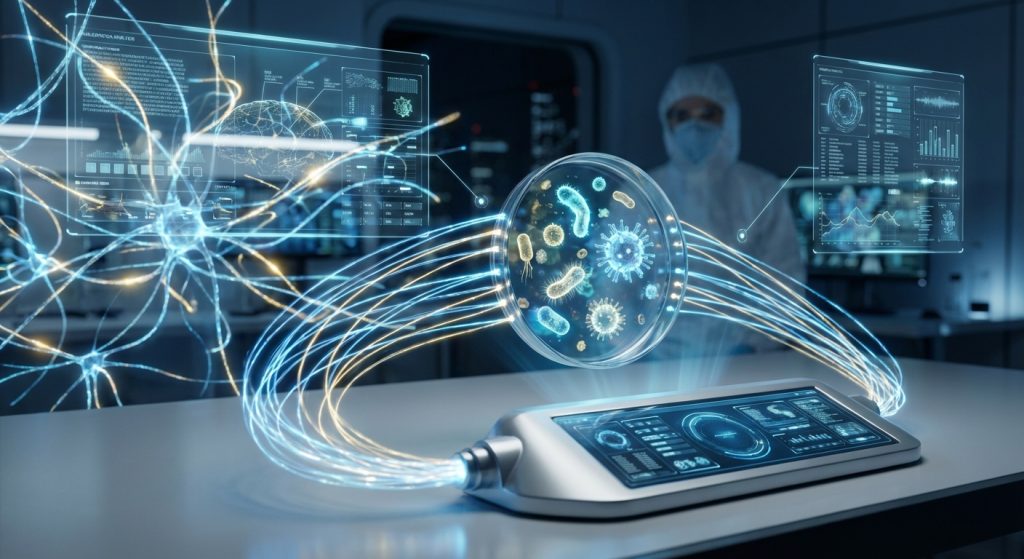
The fight against infectious diseases is relentless. Discovering and identifying pathogens quickly is crucial. This is where machine learning steps in. It offers powerful new ways to detect and understand these microscopic threats. Therefore, AI-driven pathogen identification is revolutionizing healthcare. It promises faster diagnoses and better treatment strategies.
The Challenge of Pathogen Identification
Identifying the exact pathogen causing an illness can be difficult. Many diseases share similar symptoms. Traditional methods often require time-consuming lab work. This includes culturing bacteria and performing complex tests. For instance, some bacteria are very slow to grow. This can delay diagnosis significantly. Moreover, distinguishing between similar strains, like antibiotic-sensitive and resistant ones, is a major hurdle. This diagnostic uncertainty often leads to the overuse of antibiotics. Consequently, this fuels the rise of antimicrobial resistance (AMR).
Why Traditional Methods Fall Short
Conventional techniques, while reliable, have limitations. Bacterial culture, for example, can take days or even weeks. This is especially true for challenging organisms like Mycobacterium tuberculosis. Molecular methods, such as gene sequencing, are faster. However, they often require extensive sample preparation. They can also be destructive to the sample. Furthermore, these methods may not always identify pathogens in situ. This means they cannot always detect microbes in their natural environment without disruption. Therefore, new, rapid, and accurate methods are urgently needed.
Machine Learning to the Rescue
Machine learning (ML) algorithms excel at finding patterns in complex data. In pathogen identification, ML can analyze vast amounts of information. This data can come from various sources. ML models can learn to distinguish between different pathogens based on subtle differences. This allows for much faster and more accurate identification. As a result, ML is becoming an indispensable tool in modern diagnostics.
How ML Works in Pathogen ID
ML models are trained on large datasets. These datasets contain features or “fingerprints” of different pathogens. For example, Raman spectroscopy can capture unique molecular signatures of bacteria. These signatures are then fed into ML algorithms. The algorithms learn to classify new samples based on these learned patterns. This process is similar to how humans learn to recognize objects. The more data the model sees, the better it becomes at identification. Thus, ML offers a scalable and efficient solution.

Key ML Techniques Used
Several ML techniques are employed in pathogen identification. Random forest classification is one such method. It uses multiple decision trees to make predictions. This approach can handle complex datasets effectively. Other techniques include support vector machines (SVMs) and deep learning models. Each has its strengths depending on the data and the specific problem. For instance, deep learning is particularly good at image recognition. This can be applied to microscopy or other visual diagnostic tools.
Innovations in ML-Powered Pathogen Detection
Recent advancements have shown the immense potential of ML in this field. One notable approach combines Raman spectroscopy with machine learning. This method allows for label-free detection of pathogens. It can even identify them at the single-cell level. This is a significant leap forward. For example, studies have shown accuracies of over 90% for identifying 12 common pathogenic bacteria. Furthermore, this technique can distinguish between antibiotic-sensitive and resistant strains with remarkable precision, sometimes achieving over 99% accuracy. This is crucial for combating antimicrobial resistance.
Raman Spectroscopy and ML Synergy
Raman spectroscopy provides a unique molecular fingerprint of a cell. It detects vibrations of molecules within the cell. This allows for identification without any labels or dyes. When combined with ML, these spectral fingerprints become powerful diagnostic data. The ML model learns to associate specific spectral patterns with particular pathogens or resistance mechanisms. For instance, researchers found that sensitive strains had a higher nucleic acid-to-protein ratio. In contrast, resistant strains showed more amide II structures in their proteins. Therefore, this combination offers a rapid, culture-independent, and label-free diagnostic pathway.
Sensor Arrays and ML for Broader Detection
Another exciting area is the use of sensor arrays. These arrays, often called “chemical noses,” are designed to detect a wide range of substances. When combined with ML, they can identify pathogens by sensing their unique chemical properties. These properties can include surface molecules or metabolic byproducts. Sensor arrays leverage the disparities in both extrinsic properties (like surface charge) and intrinsic properties (like enzyme activity) among different pathogens. The ML algorithms then process the signals from the sensor array to identify the pathogen. This approach is promising for developing versatile diagnostic devices.
Applications and Impact in Healthcare
The implications of ML-driven pathogen identification are far-reaching. Primarily, it can significantly speed up diagnosis in clinical settings. This allows for quicker initiation of appropriate treatment. Consequently, patient outcomes can improve dramatically. For AI healthcare startups, this presents a massive opportunity. Developing accurate and accessible ML-based diagnostic tools is key.
Accelerating Diagnosis and Treatment
Imagine a scenario where a patient presents with flu-like symptoms. Instead of waiting days for lab results, an ML-powered device could identify the specific virus or bacteria within minutes. This would allow doctors to prescribe the correct antiviral or antibiotic immediately. It could also help differentiate between bacterial and viral infections. This is critical, as antibiotics are ineffective against viruses. Therefore, faster, more precise identification leads to more effective treatment and prevents unnecessary antibiotic use.
Combating Antimicrobial Resistance (AMR)
One of the most significant benefits of ML pathogen ID is its role in fighting AMR. By accurately identifying pathogens and their resistance profiles, doctors can choose the most effective drugs. This avoids the use of broad-spectrum antibiotics when not needed. It also helps in tracking the spread of resistant strains. For example, ML can analyze genomic data to identify resistance genes. This information is vital for public health surveillance. Ultimately, this precision in diagnostics is a powerful weapon against the growing threat of superbugs. This aligns with the urgent need for antibiotic policy reform and global surveillance efforts.
Rare Disease Identification
Machine learning can also aid in identifying rare diseases. Isolated Sulfite Oxidase Deficiency (ISOD) is a rare metabolic disorder. It is caused by mutations in the SUOX gene. Symptoms can mimic more common neurological conditions. Researchers have used ML to predict the pathogenicity of SUOX missense variants. They identified 15 novel ISOD-causing variants. This work generated a databank of pathogenic variants. This supports future diagnosis of ISOD patients. Thus, ML can shed light on conditions that are often overlooked.
The Future of ML in Pathogen ID
The field is rapidly evolving. We can expect even more sophisticated ML models and detection technologies. The integration of ML with other advanced technologies will be key. This includes advancements in sensor technology, genomics, and data analytics. The goal is to create comprehensive diagnostic platforms that are fast, accurate, and accessible globally.
Integration with Wearable Devices and IoT
The future might see ML pathogen detection integrated into wearable devices. Imagine a smart patch that can detect early signs of infection. Or a device that monitors for specific biomarkers in real-time. The Internet of Things (IoT) will play a crucial role. Connected devices can share data rapidly. This allows for faster outbreak detection and response. This is similar to how smart stethoscopes are beginning to detect conditions like sepsis early.
Ethical Considerations and Data Privacy
As with any AI application in healthcare, ethical considerations are paramount. Data privacy is a major concern. Patient data must be handled securely and responsibly. Transparency in how ML models make decisions is also important. Ensuring fairness and avoiding bias in algorithms is crucial. AI healthcare startups must prioritize these aspects. They need to build trust with both healthcare providers and patients.
Frequently Asked Questions (FAQ)
What is machine learning pathogen identification?
It is the use of artificial intelligence algorithms to analyze data and identify disease-causing microorganisms like bacteria, viruses, and fungi. This process is much faster and often more accurate than traditional methods.
How does Raman spectroscopy help in pathogen identification?
Raman spectroscopy captures the unique molecular “fingerprint” of a pathogen. Machine learning algorithms then analyze these fingerprints to identify the specific microbe. It’s a label-free and culture-independent technique.
What are the main benefits of using ML for pathogen ID?
The main benefits include faster diagnosis, improved accuracy, better differentiation of strains (like antibiotic-resistant ones), and a crucial role in combating antimicrobial resistance.
Can ML help identify rare diseases?
Yes, ML can analyze genetic data and patient information to help predict the pathogenicity of genetic variants, aiding in the diagnosis of rare inherited disorders.
What are the challenges for AI healthcare startups in this field?
Challenges include data acquisition and quality, algorithm validation, regulatory approval, ensuring data privacy and security, and integrating solutions into existing healthcare workflows.
Conclusion
Machine learning is transforming pathogen identification. It offers unprecedented speed and accuracy. This is vital for diagnosing diseases, treating infections effectively, and combating the growing threat of antimicrobial resistance. As AI continues to advance, we can expect even more groundbreaking innovations. These will undoubtedly lead to a healthier future for all. For AI healthcare startups, the potential is immense. By focusing on robust, ethical, and user-friendly solutions, they can play a pivotal role in this revolution.
