

Understanding and tracking Scope Three emissions is crucial for businesses today. It helps build a sustainable future. Many companies focus on their direct emissions. However, indirect emissions are often the largest part of their carbon footprint. Therefore, addressing Scope Three is no longer optional. It’s a business imperative.
This article will guide Supply Chain Leads. We will explore what Scope Three emissions are. We will also discuss why they matter. Furthermore, we will cover how to effectively track them. This knowledge is vital for compliance and for building a greener supply chain.
What Are Scope Three Emissions?
Emissions are categorized into three scopes. These are defined by the Greenhouse Gas (GHG) Protocol. Scope One covers direct emissions. These come from sources owned or controlled by the company. Think of company vehicles or on-site fuel combustion. Scope Two covers indirect emissions. These are from purchased electricity, steam, heating, and cooling. Scope Three is different. It includes all other indirect emissions. These occur in the value chain of the reporting company. This means emissions from suppliers and customers are included.
Scope Three emissions are often the most complex. They are also usually the largest. For many businesses, they can represent over 80% of their total carbon footprint. Therefore, understanding this scope is critical for meaningful climate action. It requires looking beyond the company’s own operations.
Why Tracking Scope Three Matters
Tracking Scope Three emissions offers numerous benefits. Firstly, it provides a complete picture of a company’s environmental impact. This holistic view is essential for effective sustainability strategies. Secondly, it helps identify risks and opportunities within the value chain. For instance, a company might discover dependencies on high-emission suppliers. This could lead to supply chain disruptions or reputational damage.
Moreover, regulatory bodies and investors are increasingly demanding transparency. They want to see robust Scope Three reporting. Failing to track these emissions can lead to compliance issues. It can also deter investors. Furthermore, proactive tracking allows companies to innovate. They can develop more sustainable products and processes. This can lead to cost savings and competitive advantages. For example, optimizing logistics can reduce fuel consumption and emissions.
In conclusion, Scope Three tracking is vital for several reasons:
- Comprehensive environmental impact assessment.
- Identification of value chain risks and opportunities.
- Meeting stakeholder expectations for transparency.
- Driving innovation and competitive advantage.
- Ensuring regulatory compliance.
The Complexity of Scope Three Categories
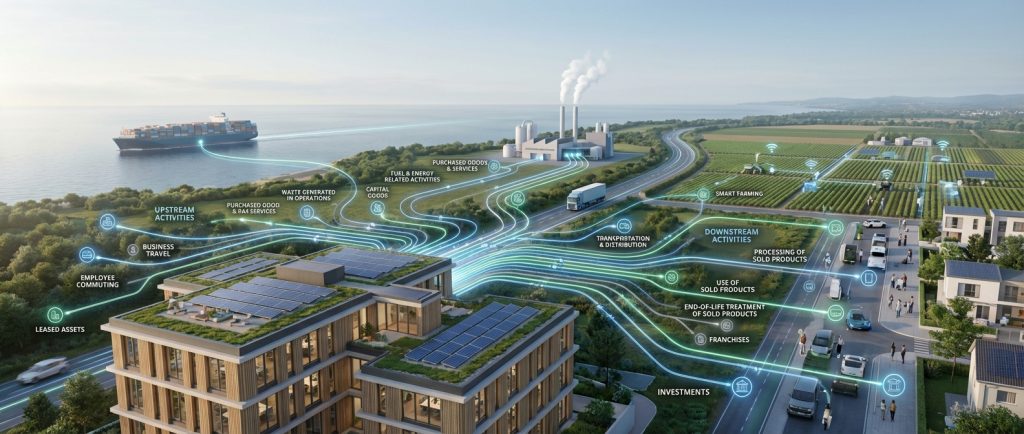
The GHG Protocol defines 15 distinct categories for Scope Three emissions. This highlights the complexity involved. These categories cover a wide range of activities. They include purchased goods and services, capital goods, fuel- and energy-related activities, upstream transportation and distribution, waste generated in operations, business travel, employee commuting, upstream leased assets, downstream transportation and distribution, processing of sold products, use of sold products, end-of-life treatment of sold products, downstream leased assets, franchises, and investments.
For example, “purchased goods and services” includes emissions from the extraction, production, and transportation of all materials the company buys. “Use of sold products” accounts for emissions generated when customers use the company’s products. This wide scope means that tracking requires collaboration across many departments and with external partners. It’s a significant undertaking, but essential for accurate reporting.
How to Track Scope Three Emissions
Tracking Scope Three emissions begins with a clear understanding of the value chain. This involves mapping out all key suppliers, distributors, and end-users. The process can be broken down into several key steps:
1. Define Boundaries and Set Goals
Firstly, determine which Scope Three categories are most relevant. Not all 15 categories will apply to every business. Focus on those with the highest potential for emissions. Setting clear, measurable goals is also important. This provides direction and helps track progress over time. For instance, a goal might be to reduce emissions from purchased goods by 20% in five years.
2. Collect Data
Data collection is the most challenging aspect. It requires robust systems and processes. Companies can use a mix of primary and secondary data. Primary data comes directly from suppliers or from company-specific research. Secondary data involves using industry averages or emission factors. For instance, the carbon footprint of a specific material can be estimated using industry databases. However, obtaining direct data from suppliers is always preferable for accuracy. This is why building strong supplier relationships is key. Many companies are now looking towards ESG data integrity to ensure the reliability of their collected information.
3. Calculate Emissions
Once data is collected, emissions need to be calculated. This involves using emission factors. Emission factors are multipliers that convert activity data into greenhouse gas emissions. For example, if a company knows it purchased 100 tons of steel, it can use an emission factor for steel production to calculate the associated emissions. Tools and software are available to assist with these calculations. These tools can streamline the process. They also help ensure consistency in methodology.
4. Analyze and Report
After calculation, the data needs to be analyzed. This helps identify emission hotspots. It also reveals areas for improvement. Reporting is the final step. This involves communicating the findings internally and externally. Transparent reporting builds trust with stakeholders. It also demonstrates commitment to sustainability. This aligns with the growing need for transparent ESG reporting.
Challenges in Scope Three Tracking
Several challenges make Scope Three tracking difficult. One major hurdle is data availability and quality. Suppliers may not have the capacity or willingness to provide detailed emission data. This forces companies to rely on estimations and averages. These can be less accurate. Another challenge is the sheer breadth of the value chain. Managing data from hundreds or thousands of suppliers is a monumental task.
Furthermore, the methodologies for calculating Scope Three emissions are still evolving. Different approaches can lead to varying results. This can cause confusion and make comparisons difficult. Also, the cost and resources required for comprehensive tracking can be substantial. Many companies, especially smaller ones, may struggle to allocate the necessary budget and personnel. However, the long-term benefits often outweigh these initial costs. For instance, understanding your supply chain can also lead to opportunities in areas like circular supply chain tech.
Strategies for Effective Scope Three Management
Despite the challenges, effective strategies can be implemented. Collaboration is key. Engaging with suppliers is crucial. Educate them on the importance of emission tracking. Offer support and resources to help them collect data. Joint initiatives can lead to better outcomes for everyone. Building strong partnerships fosters a shared commitment to sustainability.
Leveraging technology can also make a significant difference. Specialized software can help manage data collection. It can also automate calculations and reporting. This reduces the manual effort involved. Moreover, setting clear expectations and contractual requirements for suppliers can incentivize participation. Companies can also prioritize suppliers who demonstrate strong sustainability practices.
Finally, focusing on the most impactful categories first is a smart approach. Instead of trying to tackle all 15 categories at once, prioritize those that contribute the most to the overall footprint. This makes the task more manageable. It also allows for quicker wins and demonstrable progress. This approach is similar to how companies might tackle decarbonizing heavy industry, by focusing on the most emission-intensive sectors first.
The Future of Scope Three Tracking
The landscape of Scope Three tracking is rapidly evolving. Increased regulatory pressure and growing investor demand are driving innovation. We can expect to see more standardized methodologies and better data-sharing platforms. Technology will play an even larger role, with advancements in AI and blockchain potentially improving data accuracy and traceability.
Furthermore, the concept of a circular economy is gaining momentum. This approach aims to minimize waste and maximize resource utilization. Integrating circular economy principles into supply chains can significantly reduce Scope Three emissions. For example, designing products for longevity and recyclability. This shift towards a more sustainable and responsible approach to business is undeniable. It’s no longer a niche concern but a mainstream business strategy.
Frequently Asked Questions (FAQ)
What is the difference between Scope 1, 2, and 3 emissions?
Scope 1 emissions are direct emissions from owned or controlled sources. Scope 2 emissions are indirect emissions from purchased electricity, heat, or cooling. Scope 3 emissions are all other indirect emissions in the value chain, both upstream and downstream.
Is Scope Three tracking mandatory?
While not universally mandatory across all jurisdictions, many regulations and reporting frameworks (like the GHG Protocol Corporate Standard) require or strongly encourage Scope Three reporting for a comprehensive carbon footprint. Investor and consumer pressure is also making it a de facto requirement for many businesses.
How can I get my suppliers to provide emission data?
Building strong relationships, educating them on the importance, offering support or tools, and including data requirements in contracts are effective strategies. Collaboration and shared goals are key.
What are the biggest challenges in Scope Three tracking?
The primary challenges include data availability and quality, the sheer breadth of the value chain, evolving methodologies, and the significant resources required.
Can technology help with Scope Three tracking?
Yes, absolutely. Specialized software, AI-powered tools, and blockchain technology can significantly improve data management, calculation accuracy, and traceability in Scope Three reporting.
Conclusion
Tracking Scope Three emissions is a complex but essential undertaking for any business committed to sustainability. It requires a comprehensive understanding of the value chain, robust data collection processes, and strong stakeholder engagement. While challenges exist, the benefits of accurate Scope Three tracking—including risk mitigation, innovation, and enhanced reputation—are immense.
By implementing effective strategies and leveraging technology, Supply Chain Leads can navigate this complexity. They can contribute significantly to their company’s environmental goals. Ultimately, this proactive approach not only benefits the planet but also strengthens the business’s resilience and competitiveness in the evolving global marketplace. Embracing Scope Three tracking is a crucial step towards a truly sustainable future. It also aligns with broader goals of transparent ESG reporting and responsible business practices.
