
Nature’s Hidden Code: Math in Spirals, Branches, Waves
Published on February 4, 2026 by Admin
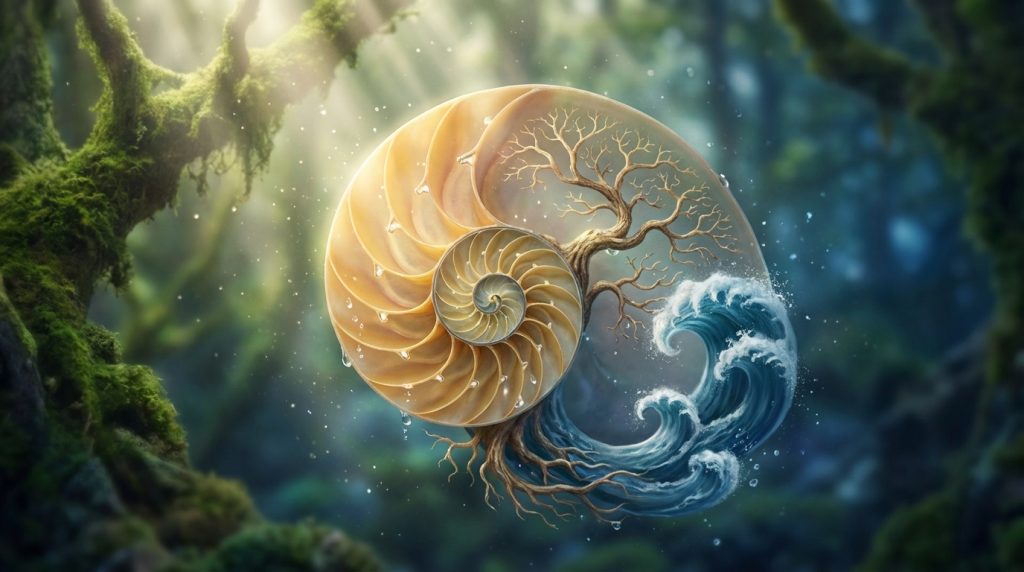
Nature is a master artist. It paints a world full of beauty. But beneath the surface lies a hidden language. This language is mathematics. We see patterns everywhere. They are in the smallest seed and the grandest tree. These patterns are not random. They follow precise mathematical rules. This article explores these fascinating connections. We will look at spirals, branches, and waves. We will uncover the mathematics of nature.
The Golden Ratio and Fibonacci’s Spirals
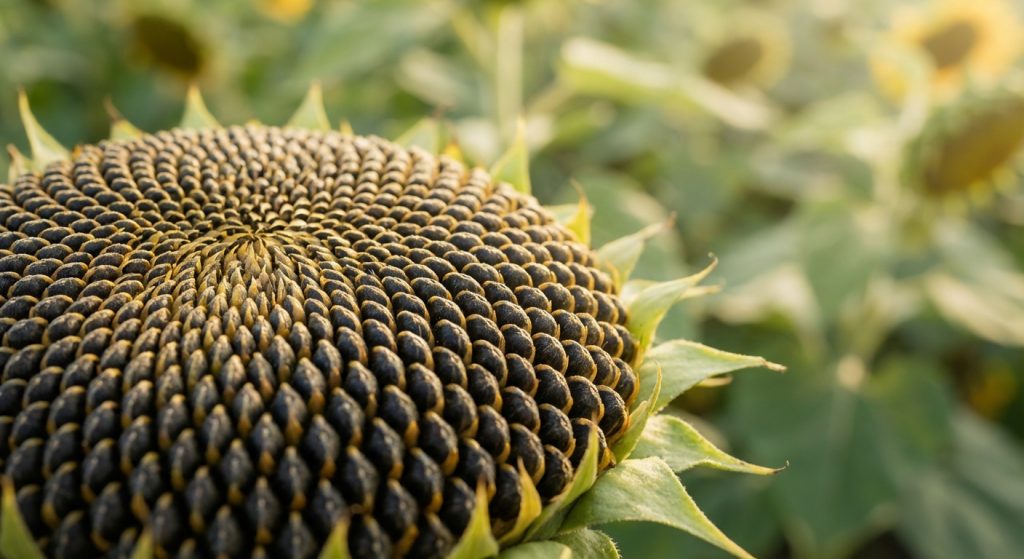
One of the most famous mathematical patterns in nature is the spiral. Think of a seashell. Consider a sunflower’s seed head. You will often find spirals here. These spirals are frequently related to the Fibonacci sequence. This sequence starts with 0 and 1. Then, each new number is the sum of the two preceding ones. So, it goes 0, 1, 1, 2, 3, 5, 8, 13, 21, and so on. This sequence appears in many natural forms. For instance, the number of petals on many flowers follows this rule. Also, the arrangement of leaves on a stem often does.
Furthermore, the ratio between consecutive Fibonacci numbers approaches a special number. This number is called the Golden Ratio, often represented by the Greek letter phi (φ). It is approximately 1.618. This ratio is found in art and architecture. It is also surprisingly common in nature. For example, the spiral arms of galaxies often exhibit this ratio. The branching of trees can also show patterns related to it. This mathematical harmony is truly remarkable. It suggests an underlying order in the universe.
Why Spirals? Efficiency and Growth
But why do these spirals appear so often? There are practical reasons. For plants, arranging leaves or seeds in a spiral pattern is efficient. It maximizes sunlight exposure. It also allows for optimal packing. For example, in a sunflower, this arrangement ensures the most seeds fit into the space. This is a form of natural optimization. It is a testament to evolution’s cleverness. The Fibonacci sequence and the Golden Ratio provide a framework for this efficient growth. They help organisms develop in ways that are both beautiful and functional.
Fractals: The Geometry of Branching and Coastlines
Another captivating mathematical concept in nature is fractals. Fractals are self-similar patterns. This means they repeat at different scales. A small part of a fractal looks like the whole structure. Think about a tree. The main trunk branches out. These branches then split into smaller ones. And those split again. Each branching pattern often resembles the overall structure of the tree. This fractal nature is not limited to trees.
Consider coastlines. If you look at a map, a coastline is irregular. Now, zoom in on a small section. You will see similar irregularities. Zoom in further, and the pattern continues. This self-similarity is a hallmark of fractals. Ferns are another classic example. Their fronds are made up of smaller fronds that look like the larger one. Even the branching of our own blood vessels and lungs exhibits fractal characteristics. This allows for maximum surface area within a limited volume. This is crucial for efficient nutrient and oxygen exchange. The mathematical elegance of fractals helps explain the complex forms we see in the natural world.
The Power of Self-Similarity
The principle of self-similarity offers significant advantages. For plants, it maximizes surface area for photosynthesis. For lungs, it maximizes gas exchange. For coastlines, it reflects geological processes acting at various scales. Therefore, fractal geometry provides an efficient way for nature to build complex structures. It does so using simple, repeating rules. This is a fundamental principle in understanding natural forms. It shows how complexity can arise from simplicity.
Waves: Rhythms of Water, Light, and Sound
Waves are fundamental to physics. They describe how energy travels. Nature is full of wave phenomena. Ocean waves are the most obvious example. Their patterns are governed by wave equations. These equations describe their shape and movement. But waves are also present in less visible forms. Light travels as waves. Sound travels as waves. Even the distribution of heat can be understood using wave-like patterns.
The patterns of waves are often described using trigonometry and calculus. For instance, the sinusoidal wave is a basic form. It appears in many natural phenomena. Ripples on a pond after a stone is dropped are a simple illustration. The crests and troughs of these waves follow predictable mathematical models. Moreover, the way light diffracts around an object or how sound waves interfere with each other are all described by wave mathematics. These mathematical descriptions allow us to predict and understand these phenomena. They are essential for fields like optics and acoustics.
Why Waves? Energy Transfer and Interaction
Waves are nature’s primary method for transferring energy. Whether it’s the energy of the sun reaching Earth as light waves, or the energy of a storm creating ocean waves, this transfer is crucial for many natural processes. Sound waves allow for communication. Other wave patterns, like those seen in sand dunes or cloud formations, result from the interaction of forces and energy flows. The mathematical principles behind wave behavior explain these interactions. They reveal how energy shapes the world around us.
The Mathematics of Growth and Form
Beyond these specific patterns, mathematics underpins many aspects of biological growth and form. For example, the way cells divide and organize during development follows mathematical principles. These principles ensure that tissues and organs form correctly. The efficiency of biological systems, from the structure of bones to the energy pathways in cells, is often optimized through mathematical relationships.
Consider the branching patterns in river systems or lightning strikes. These also show fractal-like properties. This suggests that similar mathematical principles govern growth and spread in diverse systems. Therefore, math is not just a tool for describing nature. It is, in many ways, the underlying structure of nature itself. This deep connection is a source of wonder and scientific inquiry. It helps us understand the universe better.
Internal Links for Further Exploration
The study of natural patterns often touches upon broader scientific concepts. For instance, understanding the branching of trees and the distribution of resources can be related to the principles of agroforestry. This field explores how integrating trees into farming systems can create more diverse and sustainable ecosystems. Furthermore, the efficiency found in natural growth patterns, like the Fibonacci sequence, echoes the principles of optimization found in various biological processes. You can learn more about how nature adapts to its environment by exploring articles on topics like plant adaptation strategies.
Frequently Asked Questions (FAQ)
What is the Golden Ratio and where is it found in nature?
The Golden Ratio is an irrational number, approximately 1.618. It is often found in nature in the arrangement of leaves, the spirals of shells and galaxies, and the proportions of many living organisms. It is closely related to the Fibonacci sequence.
Are fractals only found in geometry, or also in living things?
Fractals are prevalent in nature. They are found in the branching patterns of trees, lungs, and blood vessels, as well as in coastlines, snowflakes, and ferns. Their self-similar nature allows for efficient use of space and resources.
How do mathematical patterns help plants grow?
Mathematical patterns like the Fibonacci sequence help plants arrange leaves and seeds efficiently. This maximizes sunlight exposure for photosynthesis and optimizes packing, ensuring more seeds or leaves can fit in a given space.
Can you give an example of wave mathematics in everyday life?
Certainly. Ocean waves, sound waves from a musical instrument, and ripples on water are all examples. Their shapes and behaviors are described by mathematical equations like sine waves, which help us predict how they will propagate and interact.
Conclusion: The Elegance of Mathematical Nature
In conclusion, nature’s beauty is deeply intertwined with mathematics. The elegant spirals of the Fibonacci sequence, the intricate self-similarity of fractals, and the rhythmic patterns of waves are not mere coincidences. They are the result of underlying mathematical principles. These principles drive growth, optimize form, and govern energy transfer. Understanding these connections enriches our appreciation for the natural world. It reveals a profound order. This order is both complex and beautiful. It shows us that the universe speaks a language of numbers. And this language is written everywhere we look.
