
BCI: Thought-Controlled Prosthetics Revolutionize Mobility
Published on February 5, 2026 by Admin
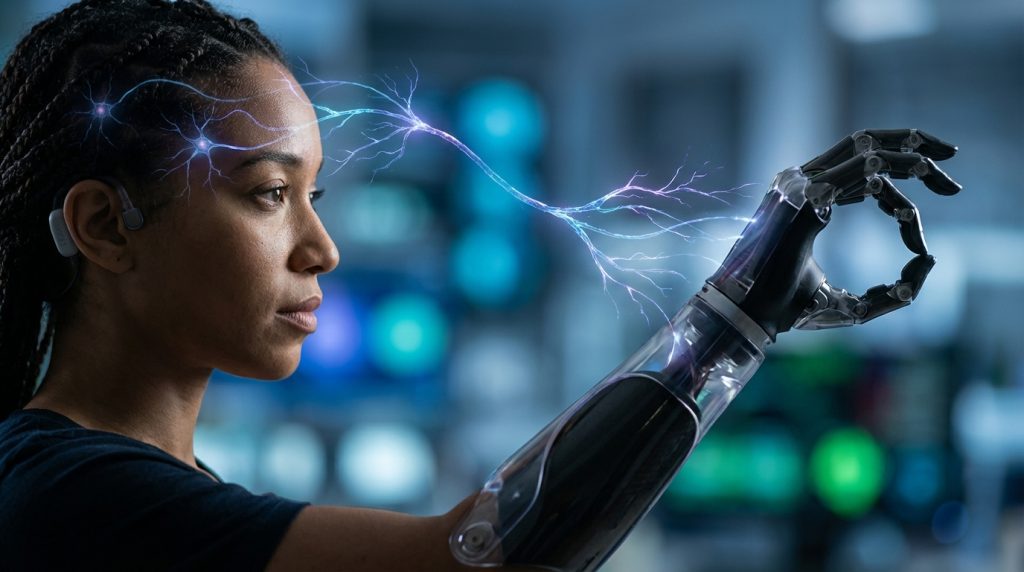
Imagine a world where movement is seamlessly restored. This is the promise of Brain-Computer Interfaces (BCIs). These advanced systems allow individuals to control prosthetic limbs using only their thoughts. Therefore, this technology offers hope for enhanced independence and quality of life. Neuroscientists and prosthetic developers are at the forefront of this exciting field. They are pushing the boundaries of what’s possible.
The Core Concept: Decoding Brain Signals
At its heart, a BCI system translates brain activity into commands. This process begins with sensing neural signals. These signals are electrical impulses generated by neurons. Different thoughts and intentions produce distinct patterns. Therefore, the key lies in accurately detecting and interpreting these patterns. This requires sophisticated hardware and software.
How BCIs Work: A Step-by-Step Breakdown
Firstly, signal acquisition is crucial. Electrodes, either on the scalp (non-invasive) or implanted in the brain (invasive), capture brain signals. Non-invasive methods, like EEG, are safer. However, they capture less precise signals. Invasive methods provide higher fidelity data. They are, however, more complex and carry risks.
Secondly, signal processing filters out noise. Brain signals are often mixed with other electrical activity. Therefore, advanced algorithms are used to isolate relevant brain patterns. This cleaning process is vital for accurate interpretation.
Thirdly, feature extraction identifies key characteristics. These characteristics represent specific intentions. For example, imagining moving a hand might create a particular neural signature. Finally, the system translates these features into control signals for the prosthetic device.
Types of BCIs for Prosthetic Control
BCIs can be broadly categorized. They are often classified by how they acquire brain signals. This distinction is important for understanding their applications and limitations.
Non-Invasive BCIs
Non-invasive BCIs use sensors placed on the scalp. Electroencephalography (EEG) is the most common method. EEG measures electrical activity from large populations of neurons. Therefore, it’s relatively easy to implement. However, the signals are less precise. This can limit the dexterity of the controlled prosthetics. Nevertheless, they offer a safer and more accessible option for many users.
Invasive BCIs
Invasive BCIs involve surgical implantation of electrodes. These can be placed on the surface of the brain (ECoG) or directly within the brain tissue (microelectrode arrays). As a result, they capture much more detailed and precise neural signals. This allows for finer control over prosthetic movements. However, surgery carries risks of infection and tissue damage. Moreover, long-term stability of implanted electrodes can be a challenge.
Semi-Invasive BCIs
Some approaches fall in between. For instance, ECoG involves placing electrodes on the dura mater, the outermost membrane of the brain. This offers a good balance between signal quality and invasiveness. Consequently, it’s an attractive option for research and clinical applications.
The Role of Machine Learning and AI
Machine learning (ML) and Artificial Intelligence (AI) are indispensable for BCI technology. They play a critical role in decoding complex brain signals. Therefore, these tools are essential for making BCIs practical and effective.
Decoding Intentions with AI
AI algorithms learn to recognize patterns associated with user intentions. Initially, users might need extensive training. They practice imagining specific movements. The AI system then learns to map these thoughts to prosthetic actions. As a result, over time, the system becomes more adept at interpreting the user’s commands. This continuous learning is a key feature of modern BCIs.
Adapting to User Needs
Furthermore, AI allows BCIs to adapt. Brain signals can change over time. For example, fatigue or learning can alter patterns. AI systems can adjust their models accordingly. This ensures consistent and reliable control. It also helps to personalize the BCI experience for each user.
This adaptive capability is crucial for long-term usability. It ensures the prosthetic remains responsive as the user’s needs evolve. For instance, if a user develops a new way of thinking about a movement, the AI can learn it.
Challenges and Limitations
Despite significant progress, several challenges remain. Overcoming these hurdles is key to widespread adoption.
Signal Reliability and Robustness
Firstly, BCI signals can be prone to noise and interference. This is especially true for non-invasive methods. Therefore, ensuring consistent and reliable signal detection is paramount. Factors like electrode placement and environmental noise can impact performance. Thus, robust signal processing is essential.
User Training and Cognitive Load
Secondly, training users can be time-consuming. It requires significant cognitive effort. Users must learn to generate specific mental commands. This can be tiring. Therefore, reducing the learning curve and cognitive load is a major goal. Streamlined training protocols are actively being developed.
Ethical Considerations and Accessibility
Moreover, ethical considerations are vital. These include data privacy and security. Questions about autonomy and responsibility also arise. Furthermore, accessibility remains a concern. The cost and complexity of current BCI systems can limit their availability. Therefore, making this technology affordable and user-friendly is a priority.
Future Directions and Innovations
The field of BCIs is rapidly evolving. Innovations promise even more sophisticated control and functionality.
Enhanced Dexterity and Sensory Feedback
Future BCIs aim for greater prosthetic dexterity. This means enabling users to perform more complex tasks. Imagine controlling individual fingers with precision. Additionally, researchers are working on providing sensory feedback. This would allow users to feel touch or pressure through the prosthetic. Such feedback would greatly enhance embodiment and control.
Integration with Other Technologies
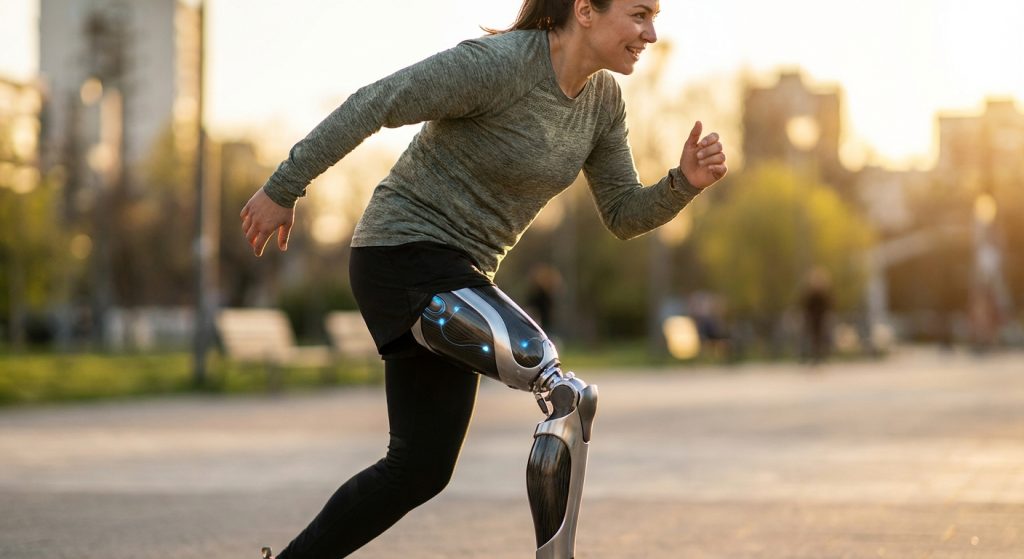
BCIs will likely integrate with other emerging technologies. For example, combining BCIs with advanced robotics could lead to highly sophisticated prosthetics. Furthermore, the interplay between BCIs and technologies like exoskeletons holds immense potential for restoring mobility.
The synergy between BCIs and other assistive technologies will be crucial. It will create more holistic solutions for individuals with disabilities. This integration promises a future where technology seamlessly augments human capabilities.
Towards Seamless, Intuitive Control
Ultimately, the goal is seamless, intuitive control. Users should be able to operate their prosthetics as naturally as their own limbs. This involves not just motor control but also sensory integration. Therefore, continued research into neural decoding and prosthetic design is essential.
Conclusion: A New Era of Human Augmentation
Brain-Computer Interfaces for prosthetic control represent a paradigm shift. They are moving beyond mere assistance to true restoration of function. For neuroscientists, this is a frontier of understanding the brain. For prosthetic developers, it’s an opportunity to create life-changing devices. As the technology matures, it promises to unlock new levels of independence and capability for countless individuals.
Frequently Asked Questions (FAQ)
What exactly is a Brain-Computer Interface (BCI)?
A BCI is a system that allows direct communication between the brain and an external device. It interprets brain signals to perform actions, such as controlling a computer cursor or a prosthetic limb.
How do BCIs allow control of prosthetic limbs?
BCIs detect brain signals related to intended movements. These signals are then translated into commands that move the prosthetic limb. This process involves sensing brain activity, processing it, and then sending control signals to the prosthetic.
What is the difference between invasive and non-invasive BCIs?
Non-invasive BCIs use sensors placed on the scalp (like EEG) and are safer. Invasive BCIs involve surgically implanted electrodes for more precise signal detection but carry higher risks.
How long does it take to learn to use a BCI?
The training time varies greatly. It depends on the BCI type, the user’s individual brain patterns, and the complexity of the task. Some users can achieve basic control in weeks, while others may require months of practice.
Will BCIs eventually replace traditional prosthetics?
It’s unlikely to be a complete replacement. Instead, BCIs will likely enhance and augment traditional prosthetics, offering more intuitive and natural control. They represent an evolution rather than a revolution that discards existing technology.
What are the main challenges in BCI development?
Key challenges include signal reliability, the need for extensive user training, high cognitive load, cost, and accessibility. Ethical considerations regarding data privacy and autonomy are also critical.
What is the future potential of BCI technology?
Future potential includes achieving more dexterous control, providing sensory feedback to users, integrating with other advanced technologies like robotics and exoskeletons, and ultimately offering seamless, intuitive control over artificial limbs and other devices.
