
The Future of Organs: 3D Printing with Human Cells
Published on February 5, 2026 by Admin
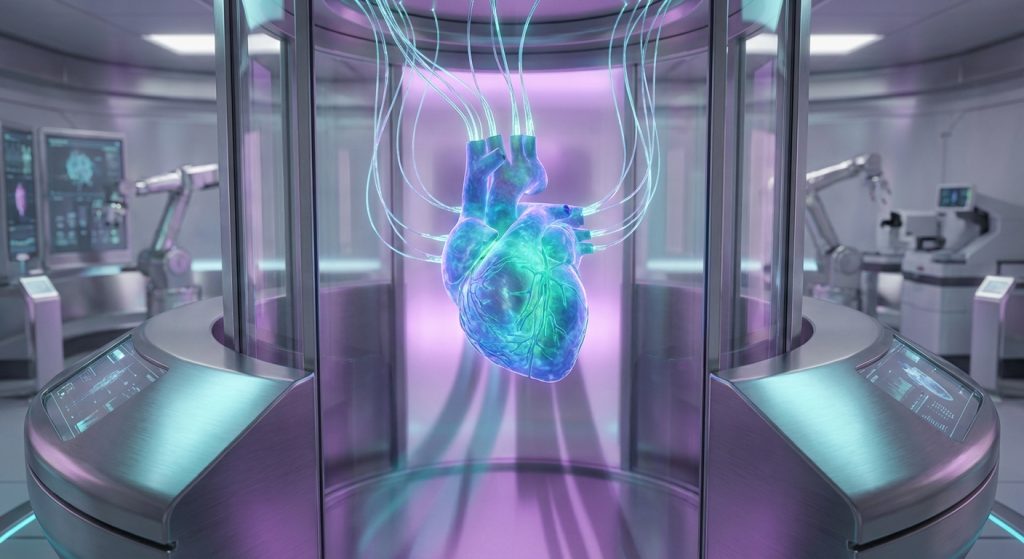
Imagine a world where organ transplant waiting lists are a thing of the past. This is the promise of regenerative medicine. Specifically, it’s about printing human organs using 3D technology and living cells. This revolutionary field is rapidly advancing. It offers hope for millions worldwide. Indeed, it could transform healthcare as we know it.
Biotechnologists and futurists are captivated. They see immense potential. This technology could solve critical organ shortages. It also opens doors to personalized treatments. Furthermore, it could accelerate drug discovery. Therefore, understanding this progress is vital.
The Organ Shortage Crisis
Currently, organ donation is the primary source. However, demand far outstrips supply. Many patients die waiting. This is a global problem. For instance, thousands of people need new kidneys, livers, or hearts. Sadly, many never receive them. Therefore, new solutions are urgently needed.
Traditional transplantation faces many hurdles. These include donor availability and tissue rejection. Moreover, patients need lifelong immunosuppression. This makes transplants complex and risky. Consequently, researchers are exploring alternatives. Regenerative medicine is one such avenue.
What is Regenerative Medicine?
Regenerative medicine aims to repair or replace damaged tissues. It uses the body’s own healing abilities. Stem cells are often key players. These cells can develop into many different cell types. They can then be guided to form specific tissues or organs.
The ultimate goal is to restore function. This could be for damaged hearts, diseased kidneys, or failing lungs. It’s about rebuilding from within. Therefore, it represents a paradigm shift. It moves from managing symptoms to true restoration.
3D Bioprinting: A New Frontier
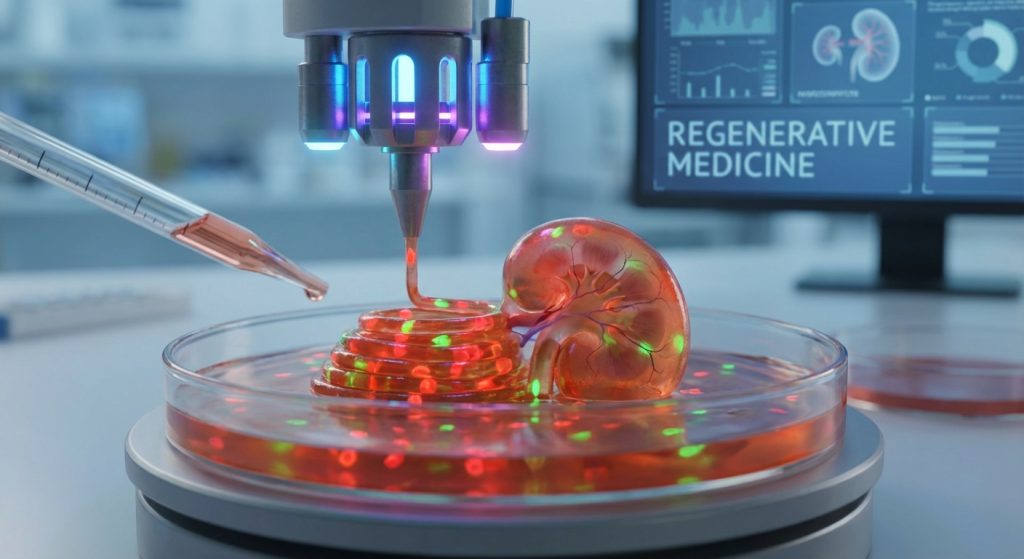
3D bioprinting combines biology and engineering. It uses specialized printers. These printers deposit “bio-ink.” Bio-ink contains living cells. It also includes biomaterials. These materials provide a scaffold. They support cell growth and organization.
The process is precise. It mimics natural tissue formation. Firstly, a digital model of the organ is created. This model is based on scans or designs. Then, the printer builds the organ layer by layer. It uses bio-ink to deposit cells and scaffold materials. As a result, complex structures can be built.
The Building Blocks: Bio-inks and Scaffolds
Choosing the right bio-ink is crucial. It must contain viable cells. These cells must be able to differentiate. They also need to survive the printing process. Common cell sources include patient-derived stem cells. This personalization reduces rejection risks.
The scaffold material is equally important. It provides structural support. It also guides cell growth. Ideally, it should be biocompatible. Furthermore, it should degrade over time. This allows the cells to form their own matrix. Hydrogels are popular choices. They mimic the natural extracellular matrix.
Challenges in 3D Organ Printing
Despite rapid progress, significant challenges remain. Printing a fully functional organ is complex. The vascularization of printed organs is a major hurdle. Organs need intricate networks of blood vessels. These supply nutrients and remove waste. Without them, printed tissues die.
Another challenge is cell survival and integration. Cells must not only survive printing but also mature. They need to function collectively. They must form specialized tissues. Moreover, scaling up production is difficult. Printing large, complex organs is time-consuming and expensive.
Vascularization: The Blood Vessel Network
Creating a functional vascular network is paramount. It’s like building a city’s road system. Without it, cells far from the surface cannot survive. Researchers are developing innovative techniques. Some involve printing channels directly. Others use sacrificial materials that are later dissolved. These create hollow pathways for blood flow.
The density and complexity of these networks are key. They must match native organ structures. This is a significant engineering feat. Therefore, it remains an active area of research. For instance, scientists are exploring co-printing cells with vascular precursors.
Cell Viability and Maturation
Ensuring cells remain alive and functional is critical. The printing process can be stressful. High pressures or shear forces can damage cells. Therefore, gentle printing methods are essential. Furthermore, printed constructs need time to mature. They require specific biochemical and mechanical cues.
These cues help cells differentiate properly. They also encourage tissue formation. This maturation process can take weeks or months. It often requires bioreactors. These devices provide controlled environments. They mimic physiological conditions. Thus, they aid in tissue development.
Potential Applications and Future Impact
The implications of successful 3D organ printing are vast. Firstly, it could eliminate organ waiting lists. Patients could receive custom-printed organs. These would be a perfect match. This would drastically reduce rejection rates. It would also improve patient outcomes.
Secondly, it can revolutionize drug testing. Instead of animal models, scientists could use printed human tissues. This would provide more accurate results. It would also be more ethical. This could accelerate the development of new medicines. For example, testing drug toxicity on a printed liver could be safer. This also relates to advancements in nanotechnology in drug delivery.
Personalized Medicine and Disease Modeling
3D bioprinting enables true personalized medicine. Organs can be printed using a patient’s own cells. This means no immunosuppression is needed. It also means organs are perfectly suited to the individual. This is a major step forward.
Furthermore, researchers can print diseased tissues. These models can help understand disease progression. They can also be used to test novel therapies. This is invaluable for diseases like cancer or Alzheimer’s. It offers a way to study complex biological processes. It also aids in developing targeted treatments. For example, studying cancer progression on printed tumor models could lead to breakthroughs.
Beyond Organs: Tissues and Beyond
The technology isn’t limited to whole organs. It can also be used for printing specific tissues. Skin grafts for burn victims are already a reality. Cartilage for joint repair is another area of development. Furthermore, printed muscle tissue could aid in injury recovery.
The potential extends to creating organoids. These are miniature, simplified versions of organs. They are useful for research. They provide insights into organ development and function. Therefore, the applications are diverse and growing.
Ethical Considerations and Societal Impact
As with any groundbreaking technology, ethical questions arise. Who will have access to this technology? Will it be affordable and accessible to all? Ensuring equitable access is crucial. Otherwise, it could widen healthcare disparities.
Questions about the definition of life and humanity may also emerge. However, the primary focus currently is on therapeutic benefits. The societal impact could be profound. It could extend lifespans. It could also improve quality of life significantly.
The Road Ahead
The journey to fully functional, printed organs is ongoing. However, progress is accelerating. Researchers are overcoming technical hurdles. Funding and collaboration are increasing. Therefore, the future looks promising.
We are witnessing a revolution. It’s a revolution in how we treat disease. It’s a revolution in how we understand life itself. Ultimately, 3D organ printing holds the key. It could unlock a future of restored health and extended life. This aligns with broader advancements in regenerative medicine.
Frequently Asked Questions
When will 3D printed organs be widely available?
While significant progress has been made, widespread clinical availability of complex 3D printed organs is still some years away. Simpler tissues and organoids are closer to reality. However, printing intricate organs like hearts or lungs involves substantial challenges, particularly in vascularization and long-term functionality. Experts anticipate it will take at least another decade or more for fully functional organs to be routinely transplanted.
Can 3D printed organs be rejected by the body?
One of the biggest advantages of 3D bioprinting is the potential to use a patient’s own cells. When an organ is printed using autologous (patient-derived) cells, the risk of immune rejection is significantly minimized. This is a major improvement over traditional organ transplants, which require lifelong immunosuppression to prevent rejection.
What are the main challenges in 3D organ printing?
The primary challenges include:
- Vascularization: Creating a functional network of blood vessels to supply nutrients and remove waste.
- Cell Viability and Maturation: Ensuring cells survive the printing process and mature into functional tissues.
- Scale and Complexity: Printing large, complex organs with intricate structures.
- Biomaterial Development: Finding suitable, biocompatible, and biodegradable scaffold materials.
- Regulatory Approval: Navigating the complex process of getting new medical technologies approved for human use.
Therefore, overcoming these requires interdisciplinary collaboration.
How is 3D printing of organs different from traditional organ transplantation?
Traditional transplantation relies on deceased or living donors. This leads to a critical shortage of organs. 3D bioprinting aims to create organs on demand, using a patient’s own cells. This eliminates the need for donors and drastically reduces the risk of immune rejection. Moreover, it offers a personalized approach to treatment.
What role do stem cells play in 3D organ printing?
Stem cells are crucial because they can differentiate into various specialized cell types. For 3D organ printing, researchers often use induced pluripotent stem cells (iPSCs) derived from the patient. These cells are then directed to become the specific cell types needed for a particular organ, such as cardiomyocytes for a heart or hepatocytes for a liver.
Conclusion
Regenerative medicine, particularly 3D bioprinting of organs, represents a monumental leap forward. It holds the promise of solving the critical organ shortage. It also paves the way for highly personalized and effective treatments. While significant challenges remain, the ongoing research and innovation are undeniable. As biotechnologists and futurists continue to push boundaries, the dream of printing replacement organs is steadily moving closer to reality. Consequently, the future of healthcare is being reshaped.
