AI in Drug Discovery: Revolutionizing Research Speed
Published on February 6, 2026 by Admin
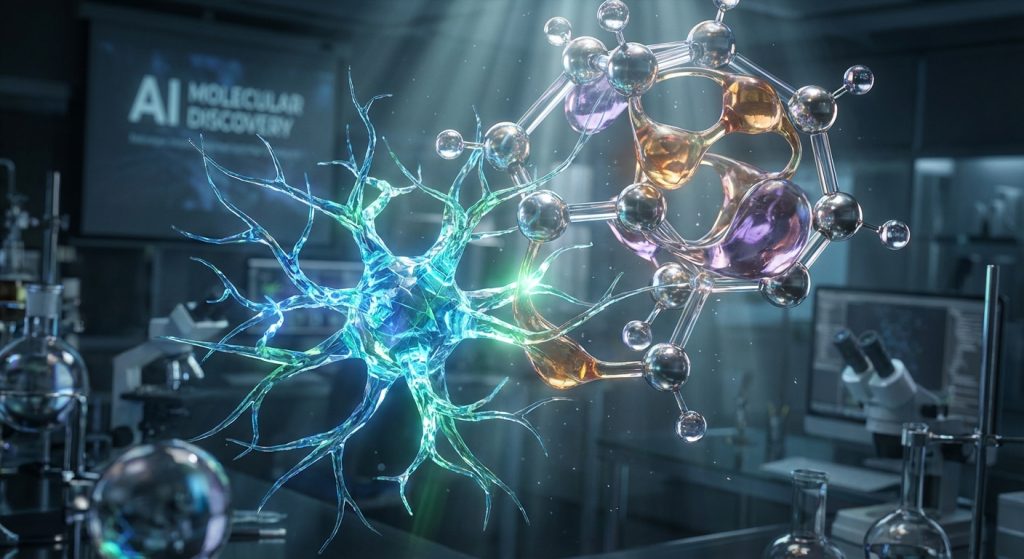
The pharmaceutical industry faces immense pressure. Developing new drugs is a lengthy, costly, and often unpredictable process. Traditionally, it can take over a decade. It also costs billions of dollars. Many promising compounds fail late in development. This presents a significant challenge for both Pharma CEOs and AI researchers.
However, a powerful new ally has emerged: Artificial Intelligence. AI is transforming drug discovery. It offers the potential to drastically reduce timelines and increase success rates. Therefore, understanding AI’s role is crucial for innovation.

The Traditional Drug Discovery Bottleneck
Historically, drug discovery followed a linear path. This path was fraught with challenges. Firstly, it involved extensive laboratory research. Scientists explored vast numbers of potential drug candidates. This process was often manual and time-consuming. Secondly, identifying disease targets was complex. Understanding biological pathways required deep investigation.
Furthermore, preclinical testing was rigorous. Animal models were used to assess safety and efficacy. This stage alone could take years. Clinical trials followed. These involved human participants and were heavily regulated. Many drugs that showed promise in labs failed during these trials. Consequently, the attrition rate was extremely high.
Challenges Faced by Pharma
- High R&D costs
- Long development cycles
- Low success rates
- Difficulty in identifying novel targets
- Complex regulatory pathways
These factors contribute to the immense cost of bringing a new drug to market. Because of these hurdles, innovation can slow down. This impacts patient access to life-saving treatments.
How AI Accelerates Drug Discovery
Artificial Intelligence offers solutions to these long-standing problems. AI algorithms can process and analyze vast datasets much faster than humans. This capability is revolutionizing every stage of drug discovery. From initial target identification to clinical trial optimization, AI is a game-changer.
For instance, AI can sift through massive genomic and proteomic data. This helps identify potential disease targets more efficiently. It can also predict how molecules will interact. This significantly speeds up the hit-to-lead optimization phase.
Key AI Applications in Drug Discovery
- Target Identification: AI analyzes biological data to pinpoint proteins or pathways involved in diseases.
- Drug Design and Synthesis: AI can predict the properties of novel molecules and suggest optimal synthesis routes.
- Virtual Screening: AI models screen millions of compounds against a target virtually, saving lab time.
- Predictive Toxicology: AI can predict potential side effects and toxicity early on.
- Clinical Trial Optimization: AI helps in patient selection, trial design, and data analysis.
As a result, AI significantly reduces the time spent on early-stage research. This allows scientists to focus on the most promising candidates. Moreover, it can uncover connections previously missed by human analysis.
AI for Target Identification and Validation
Identifying the right target is fundamental to drug discovery. AI can analyze complex biological networks. It looks for patterns in genetic data, scientific literature, and patient records. Therefore, it can identify novel targets that human researchers might overlook. This speeds up the crucial initial phase of research.
For example, AI can process thousands of research papers. It can extract relevant information about disease mechanisms. This helps in validating potential drug targets quickly. Consequently, researchers can move faster towards developing therapies.
Revolutionizing Molecular Design and Screening
Designing new molecules with desired properties is a complex art. AI models, particularly deep learning, can generate novel molecular structures. These structures are designed to bind effectively to specific targets. This generative capability is a significant leap forward.
Moreover, AI excels at virtual screening. It can evaluate millions of existing compounds. It predicts which ones are most likely to be effective. This dramatically reduces the need for expensive and time-consuming wet-lab experiments. For instance, AI can predict binding affinity with high accuracy. This allows researchers to prioritize compounds for further testing.
Predicting Efficacy and Safety with AI
One of the biggest reasons for drug failure is lack of efficacy or safety issues. AI can predict these outcomes much earlier. By analyzing vast datasets of known drugs and their effects, AI models learn patterns. These patterns relate molecular structures to biological activity and potential toxicity.
Therefore, AI can flag potential safety concerns before costly preclinical or clinical trials. This saves immense resources and time. It allows for the design of safer and more effective drugs from the outset. This predictive power is invaluable for Pharma CEOs.
You can explore how AI is revolutionizing diagnostics in our article on AI in Radiology, which highlights similar speed and accuracy gains.
Optimizing Clinical Trials with AI
Clinical trials are the most expensive and time-consuming part of drug development. AI can optimize this process significantly. Firstly, AI can identify suitable patient populations for trials. It analyzes electronic health records and genetic data. This ensures that the right patients are recruited for specific studies. As a result, trials are more likely to yield conclusive results.
Secondly, AI can help design more efficient trial protocols. It can predict potential drop-out rates. It can also analyze real-time trial data. This allows for adaptive trial designs. Thus, AI helps bring drugs to market faster and more reliably. This is a significant benefit for both patients and pharmaceutical companies.
The integration of AI into healthcare is broad. For example, AI-powered pharmacies are emerging, as discussed in AI-Powered Pharmacies.
The Role of Data and Machine Learning
At the heart of AI in drug discovery lies data. High-quality, diverse datasets are essential. These include genomic, proteomic, chemical, and clinical trial data. Machine learning algorithms learn from this data. They identify patterns and make predictions.
Different types of machine learning are used. Supervised learning is common for prediction tasks. Unsupervised learning helps in identifying hidden patterns. Reinforcement learning can be used for optimizing complex processes. Therefore, robust data infrastructure and advanced ML expertise are critical.
Challenges and Future Directions
Despite its promise, AI in drug discovery faces challenges. Data quality and accessibility remain issues. Bias in datasets can lead to skewed results. Ethical considerations surrounding AI use are also important. Furthermore, regulatory frameworks are still evolving to accommodate AI-driven discoveries. Integration into existing workflows can also be complex.
However, the future is bright. As AI technologies mature, they will become even more powerful. We can expect AI to tackle more complex diseases. It will also enable truly personalized medicine. For instance, AI could design drugs tailored to an individual’s unique genetic makeup. This represents a paradigm shift in healthcare. Ultimately, AI promises to democratize drug discovery. It will make life-saving treatments more accessible and affordable.
The ethical considerations around AI are also pertinent in other fields, such as in Gene Editing.
Frequently Asked Questions (FAQ)
How much time can AI save in drug discovery?
AI can potentially save years of research. It accelerates target identification, molecular design, and clinical trial phases. Some estimates suggest it can cut development timelines by up to 50%.
What are the biggest challenges for AI in drug discovery?
Key challenges include data availability and quality, algorithmic bias, regulatory hurdles, and the need for skilled AI professionals in the pharmaceutical sector.
Can AI replace human scientists in drug discovery?
No, AI is unlikely to replace human scientists entirely. Instead, it acts as a powerful tool. AI augments human capabilities, allowing scientists to focus on higher-level tasks and innovation.
What types of AI are most used in drug discovery?
Machine learning, particularly deep learning, is widely used. Natural Language Processing (NLP) is also employed for literature analysis. Generative AI models are increasingly used for molecular design.
What is the economic impact of AI in drug discovery?
AI can significantly reduce R&D costs by improving efficiency and success rates. This can lead to lower drug prices and faster market entry for new therapies.
Conclusion
Artificial Intelligence is not just a trend; it’s a fundamental shift in how we approach drug discovery. For Pharma CEOs, embracing AI is no longer optional but essential for competitiveness. For AI researchers, the pharmaceutical industry offers a vast and impactful frontier. By leveraging AI’s capabilities, we can overcome the traditional bottlenecks. We can accelerate the development of novel therapies. This will ultimately lead to better health outcomes for people worldwide. The future of medicine is being written with algorithms, and it’s arriving faster than ever before.