
Pteropus, commonly known as fruit bats, are fascinating creatures. They play vital roles in ecosystems. However, they also serve as reservoirs for various viruses. Understanding their immune systems is crucial. This is especially true for comparative immunologists. It helps us predict and manage zoonotic diseases. Therefore, studying Pteropus host immunity offers unique insights.
The Pteropus Immune System: A Unique Landscape
Fruit bats possess an immune system. It has adapted to their specific lifestyle. They are long-lived mammals. They also fly, which is metabolically demanding. This lifestyle likely shapes their immune responses. For instance, flying generates oxidative stress. This can lead to chronic inflammation. However, Pteropus bats seem to manage this well. Their immune system might tolerate inflammation better. This could be key to their viral reservoir status.
Consequently, Pteropus bats often show no signs of illness. They carry viruses like Nipah and Hendra. Yet, they remain healthy. This suggests a robust, yet distinct, immune strategy. It differs from many other mammals. Therefore, comparative immunologists find this area highly engaging. It offers a chance to study immune tolerance. It also sheds light on viral persistence.
Key Features of Pteropus Immunity
Several aspects of Pteropus immunity stand out. These include their inflammatory responses. They also have unique antiviral mechanisms. Furthermore, their response to pathogens is noteworthy.
Inflammatory Pathways and Tolerance
Unlike many mammals, Pteropus bats might have a dampened inflammatory response. This is a key hypothesis. Chronic inflammation can be detrimental. It damages tissues. It also makes hosts susceptible to disease. However, Pteropus bats seem to tolerate it. This tolerance may prevent them from succumbing to viral infections. It allows them to carry viruses without severe illness. This differs greatly from our understanding of Nipah viral pathogenesis.
Researchers are investigating specific molecules. These molecules likely regulate inflammation. For example, certain cytokines might be involved. Their levels might be higher or more sustained. This could contribute to immune tolerance. It’s a complex balance. Too little inflammation, and pathogens thrive. Too much, and the host suffers. Pteropus bats seem to have found a sweet spot.
Antiviral Defenses in Fruit Bats
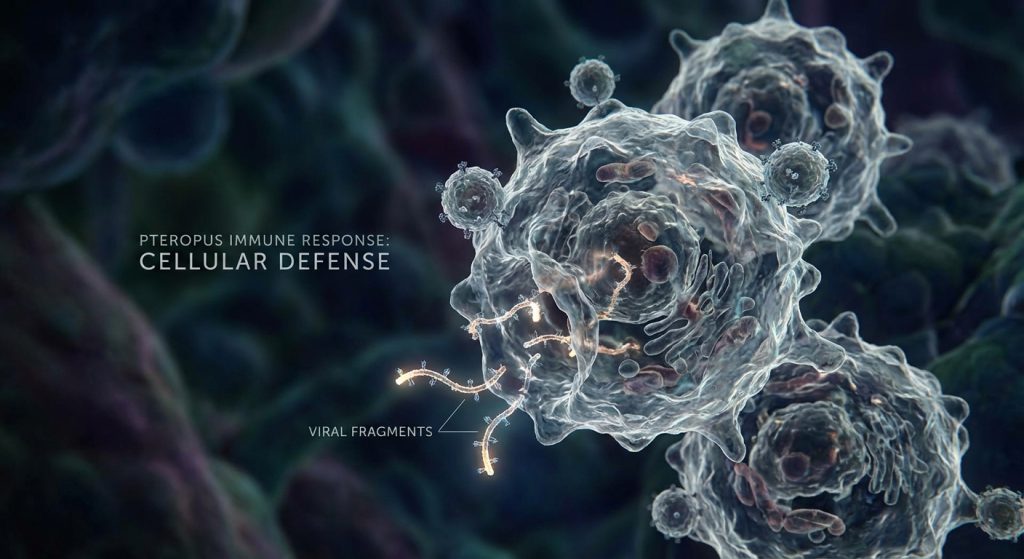
Pteropus bats exhibit strong antiviral defenses. They can control viral replication. This happens without causing excessive damage to themselves. Interferons are crucial antiviral proteins. Bats, including Pteropus species, have diverse interferon systems. These systems are constantly active. They provide a baseline defense. This likely helps them manage viral loads. It’s a sophisticated defense strategy.
Moreover, natural killer (NK) cells are important. These cells target infected cells. Pteropus bats have well-developed NK cell populations. These cells likely play a significant role. They help control viral spread. This is crucial for preventing severe disease. Understanding these mechanisms is vital for disease control.
Pathogen Tolerance and Viral Reservoirs
The ability of Pteropus bats to tolerate pathogens is remarkable. They act as natural reservoirs. This means they carry viruses long-term. They can transmit them to other species. Yet, they remain healthy. This phenomenon is central to studying zoonotic threats. It highlights a different evolutionary strategy. It’s about coexistence rather than eradication.
Therefore, Pteropus bats are key subjects. They help us understand how viruses can persist. It’s not just about the virus. It’s also about the host’s immune system. This is why studying zoonotic threat assessments is so important.
Comparative Immunological Significance
The study of Pteropus immunity is invaluable. It allows for direct comparisons. We can compare their systems to ours. We can also compare them to other mammals. This reveals evolutionary adaptations. It also shows different strategies for survival.
Lessons for Human Health
Understanding Pteropus immune tolerance is key. It could offer insights into human diseases. For example, autoimmune diseases involve excessive inflammation. Conditions like rheumatoid arthritis are examples. Learning how bats control inflammation could inspire new therapies. It might lead to novel treatments for chronic inflammatory conditions. This is a long-term goal for researchers.
Furthermore, their antiviral strategies are relevant. Learning how they manage viruses like Nipah could inform vaccine development. It might also guide antiviral drug design. The goal is to develop better defenses. This includes defenses against emerging infectious diseases. We can learn from nature’s solutions. This is a core principle of One Health strategies.
Insights into Viral Evolution
Pteropus bats provide a window. They show how viruses evolve. Viruses adapt to their hosts. They also adapt to transmission routes. By studying viruses in Pteropus, we can track their evolution. We can see how they change over time. This is crucial for predicting future outbreaks. It helps us prepare for new threats. This is especially important for understanding Nipah transmission dynamics.
Moreover, their role as reservoirs is critical. They can act as a bridge. Viruses can jump from bats to other animals. Then, they can jump to humans. This is known as zoonotic spillover. Studying Pteropus immunity helps us identify risks. It allows for early detection. Therefore, it’s a proactive approach to global health. It’s about preventing pandemics before they start.
Challenges in Pteropus Host Immunity Research
Despite its importance, this research faces hurdles. Studying bats in their natural habitat is difficult. Capturing and handling them requires expertise. Ethical considerations are also paramount. Researchers must ensure animal welfare.
Field Research and Sample Collection
Collecting biological samples from Pteropus bats is challenging. It requires specialized equipment. It also needs trained personnel. Bats are often nocturnal and agile flyers. This makes them hard to track and sample. Furthermore, environmental factors can affect immune responses. This adds another layer of complexity. Nevertheless, dedicated research continues. Technologies like bat pathogen surveillance tech are proving invaluable.
Ethical Considerations and Conservation
Research must be conducted ethically. Animal welfare is a top priority. Researchers follow strict protocols. These ensure minimal stress to the bats. Conservation efforts are also intertwined. Understanding Pteropus immunity helps protect them. It highlights their ecological importance. Protecting their habitats is essential. This ensures the health of ecosystems. It also safeguards against disease emergence. Learn more about Pteropus bat ecology and tracking to understand conservation efforts.
Future Directions in Pteropus Immunity Studies
The field is constantly evolving. New technologies offer exciting possibilities. Genomics and transcriptomics are powerful tools. They allow us to study immune genes. They also reveal gene activity. This provides a molecular-level understanding.
Genomic and Proteomic Approaches
Researchers are sequencing Pteropus genomes. They are also analyzing their proteomes. This reveals the genes involved in immunity. It shows how these genes function. It helps identify unique adaptations. For example, genes related to DNA repair might be enhanced. This could counteract oxidative stress from flying. These studies provide a blueprint. They show the genetic basis of their unique immunity. This research is essential for understanding Nipah virus genomic evolution.
In Vitro and In Vivo Models
Developing cell cultures is important. These allow for controlled experiments. Researchers can test immune responses in a lab setting. They can study how Pteropus cells react to viruses. Animal models are also useful. They help simulate natural infections. However, ethical considerations are paramount. Such models must be carefully designed. They aim to maximize knowledge gain. They also minimize harm to animals. Developing effective mRNA Nipah vaccine candidates often relies on such models.
Conclusion
Pteropus host immunity is a complex and vital area of study. It offers profound insights. These insights span immunology, virology, and conservation. Understanding how these bats manage viruses is crucial. It helps us mitigate zoonotic disease risks. It also informs our approach to wildlife conservation. Comparative immunologists continue to unravel these mysteries. Their work is essential for global health security. It’s a testament to nature’s intricate designs.
Frequently Asked Questions (FAQ)
Why are Pteropus bats important for studying immunity?
Pteropus bats are important because they act as natural reservoirs for many viruses, including Nipah and Hendra. They carry these viruses without showing symptoms, which suggests a unique immune system. Studying this system helps us understand viral persistence and immune tolerance.
What is unique about the Pteropus immune system?
Pteropus bats may have a dampened inflammatory response. This allows them to tolerate viruses without causing self-harm. They also possess robust antiviral mechanisms, likely involving strong interferon and NK cell activity, enabling them to control viral replication effectively.
How does studying Pteropus immunity help human health?
Understanding how Pteropus bats control inflammation and viral infections can inspire new treatments for human diseases. This includes autoimmune disorders and viral infections. It may lead to better vaccine strategies and antiviral therapies.
What are the main challenges in Pteropus immunity research?
Challenges include the difficulty of field research, sample collection from elusive bats, and ensuring ethical treatment and welfare during studies. Environmental factors also add complexity to interpreting results.
What are the future directions for this research?
Future research will utilize advanced techniques like genomics and proteomics to understand immune genes and their functions. In vitro and in vivo models will also be developed to study immune responses and viral interactions more closely. This work is crucial for real-time outbreak mapping and preparedness.