
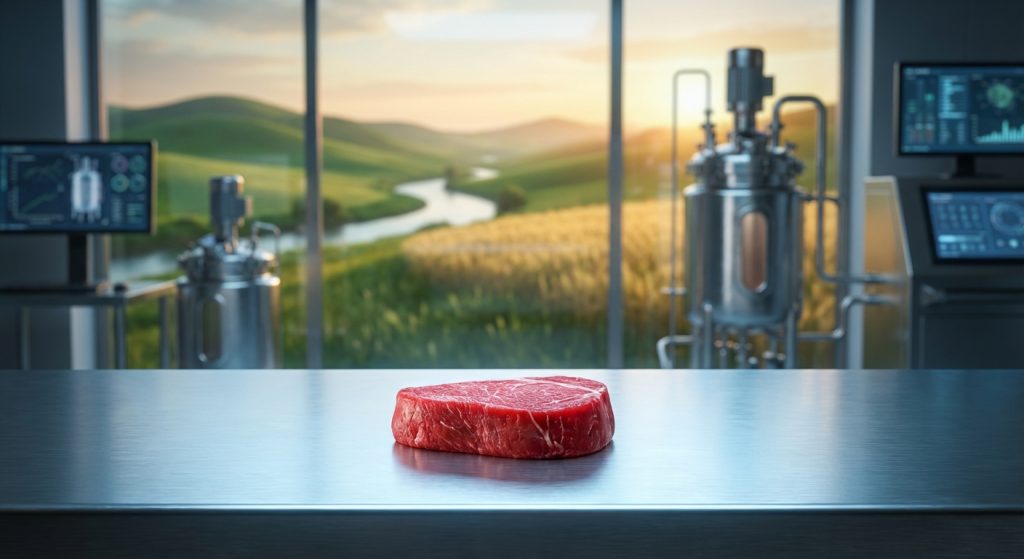
The future of food is evolving rapidly. Lab-grown meat, also known as cultured meat, is emerging as a revolutionary alternative. It promises to change how we produce and consume meat. This innovation raises significant ethical questions. Therefore, we must explore its impact on livestock farming and animal welfare. This article delves into these complex issues.
Cultured meat is grown from animal cells. These cells are nurtured in a nutrient-rich medium. This process bypasses traditional animal agriculture. As a result, it offers a potential solution to many ethical dilemmas. However, it also introduces new considerations.
Understanding Lab-Grown Meat
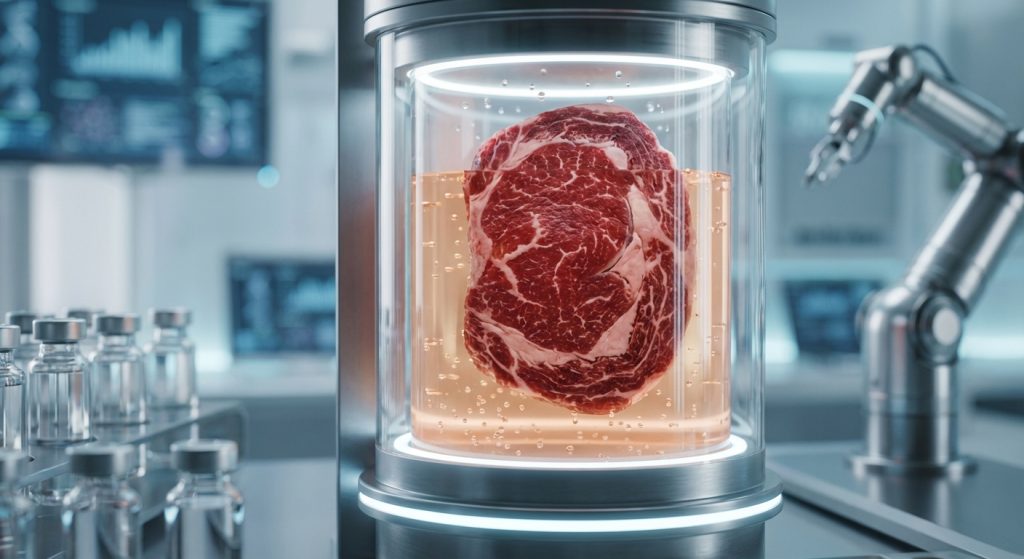
Firstly, let’s define what lab-grown meat is. It starts with a small sample of cells. These cells come from a living animal. They are then placed in a bioreactor. This is a controlled environment. Here, the cells are fed a special broth. This broth provides nutrients. It also contains growth factors. The cells multiply. They differentiate into muscle and fat tissues. Eventually, they form structured meat. This entire process is done without raising and slaughtering animals.
The technology is sophisticated. It mimics the natural growth process. However, it does so in a highly controlled setting. Therefore, it offers precise control over the final product. This also means it can potentially be tailored for specific nutritional profiles.
Impact on Livestock Farming
The rise of lab-grown meat could significantly disrupt traditional livestock farming. For decades, farming has relied on raising animals for meat. This industry is a major economic driver for many regions. It also supports countless jobs.
However, conventional livestock farming faces criticism. It is associated with environmental concerns. These include greenhouse gas emissions and land use. Furthermore, it raises ethical questions about animal treatment.
If cultured meat becomes widespread, demand for conventionally farmed meat could decrease. This would likely lead to a reduction in the number of animals farmed. Consequently, many farms might need to adapt or cease operations. This transition could be challenging for farmers and rural communities. Therefore, careful planning and support systems will be crucial.
On the other hand, some argue that cultured meat could coexist with traditional farming. Perhaps it could serve niche markets or supplement existing supply chains. Moreover, it might free up land. This land could then be used for other purposes, like reforestation or other forms of agriculture. For instance, it might enable more focus on agroforestry.
Animal Welfare Considerations
One of the most compelling arguments for lab-grown meat is its potential to improve animal welfare. Traditional farming often involves practices that raise ethical concerns. These include confinement, transportation, and slaughter methods.
With cultured meat, the need for large-scale animal husbandry is eliminated. This means no animals are raised solely for slaughter. The initial cell sample can be obtained through a biopsy. This procedure is generally considered less invasive. It can be done on a living animal. Therefore, it avoids the ethical issues associated with the end-of-life process for farmed animals.
However, the ethics are not entirely straightforward. Questions remain about the initial cell sourcing. While a biopsy is less harmful than slaughter, it still involves an animal. Furthermore, the growth mediums used might contain animal-derived components. Researchers are working to eliminate these. The goal is to create a fully animal-free product.
Moreover, some argue that focusing solely on cultured meat might devalue animals. It might lead to a perception of animals as mere biological factories. This could have unforeseen societal consequences regarding our relationship with other species.
Environmental Impact
The environmental benefits of cultured meat are a significant draw. Traditional livestock farming is resource-intensive. It requires vast amounts of land for grazing and feed production. It also contributes significantly to greenhouse gas emissions, particularly methane. Water usage is also substantial.
Cultured meat production, in theory, could drastically reduce these impacts. It requires less land and water. It also has the potential to produce fewer greenhouse gases. However, current estimates vary. The energy consumption of the bioreactors is a key factor. Furthermore, the production of growth mediums also has an environmental footprint.
More research is needed to fully assess the lifecycle environmental impact. As the technology scales up, efficiency improvements are expected. Therefore, it is likely to become more sustainable over time. Indeed, innovations in sustainable production are crucial. This includes exploring renewable energy sources for the production facilities.
It is also important to consider the broader agricultural landscape. For example, the development of vertical farming and regenerative agriculture also offer pathways to a more sustainable food system. Cultured meat could be one piece of a larger, more diversified food production puzzle.
Economic and Social Implications
The economic implications of cultured meat are vast. It could create new industries and jobs in biotechnology and food production. However, it also poses a threat to established industries. This includes traditional farming, meat processing, and related sectors.
The cost of production is currently high. This makes cultured meat more expensive than conventional meat. However, as production scales up, costs are expected to fall. Price parity is a key goal for widespread adoption. Therefore, market acceptance will depend on both price and consumer perception.
Socially, consumer acceptance is a major hurdle. Some people are uncomfortable with the idea of “unnatural” food. Others worry about the long-term health effects. Education and transparency will be vital. Consumers need to understand the science and the ethical considerations. They need to make informed choices.
Furthermore, the distribution of benefits is important. Will this technology benefit everyone, or will it exacerbate existing inequalities? Ensuring equitable access and fair economic transitions will be crucial for social harmony. This includes considering how to support farmers during this shift.
Challenges and Future Outlook
Despite its promise, cultured meat faces several challenges. These include:
- Scaling Up Production: Moving from laboratory settings to industrial-scale production is complex and expensive.
- Cost Reduction: Bringing the price down to compete with conventional meat is essential.
- Regulatory Approval: Governments worldwide are still developing frameworks for approving and labeling cultured meat products.
- Consumer Acceptance: Overcoming public skepticism and building trust is paramount.
- Nutritional Equivalence: Ensuring cultured meat is as nutritious as conventional meat, or even more so, is important.
However, the outlook is promising. Investment in the sector is growing. Technological advancements are accelerating. More companies are entering the market. Therefore, it is likely that cultured meat will play a significant role in the future food landscape.
The ethical considerations are ongoing. As the technology develops, new questions will arise. For example, the use of lab-on-a-chip diagnostics in quality control could become standard. This ensures safety and consistency.
Frequently Asked Questions
Is lab-grown meat safe to eat?
Yes, the consensus among scientists and regulatory bodies is that lab-grown meat produced under sterile conditions and meeting safety standards is safe to eat. The production process is highly controlled to prevent contamination.
Will lab-grown meat replace traditional meat entirely?
It is unlikely to replace traditional meat entirely in the short to medium term. However, it is expected to become a significant alternative. Many believe it will coexist with traditional farming, catering to different consumer preferences and ethical concerns.
What are the main ethical benefits of lab-grown meat?
The primary ethical benefit is the significant improvement in animal welfare. It eliminates the need for raising and slaughtering billions of animals. Additionally, it can reduce the environmental impact associated with conventional livestock farming.
What are the biggest challenges facing lab-grown meat production?
The major challenges include scaling up production efficiently, reducing costs to compete with conventional meat, gaining regulatory approval, and achieving widespread consumer acceptance. The development of sustainable growth mediums is also an ongoing effort.
Does lab-grown meat still require animal cells?
Yes, currently, lab-grown meat production begins with a small sample of cells taken from a living animal. However, research is ongoing to develop cell lines that can be cultured indefinitely without requiring repeated animal sampling. Additionally, efforts are being made to ensure all growth mediums are animal-free.
Conclusion
Lab-grown meat presents a fascinating and complex ethical landscape. It offers compelling solutions to issues of animal welfare and environmental sustainability. However, it also brings economic challenges and requires careful consideration of consumer acceptance and societal impact. As the technology matures, it has the potential to reshape our food systems. Therefore, ongoing dialogue and responsible innovation are essential. The journey towards a more ethical and sustainable protein source is underway. It promises a future where our food choices align better with our values.
