
The Future of Non-Invasive Surgery: Focused Ultrasound and Beyond
Published on December 25, 2025 by Admin

The medical field is constantly evolving. New technologies emerge that promise better patient outcomes. Non-invasive surgery represents a significant leap forward. It offers alternatives to traditional open procedures. Focused ultrasound is a key player in this revolution. It is transforming how we treat various conditions. Let’s explore this exciting frontier.
Understanding Focused Ultrasound (FUS)
Focused ultrasound, often abbreviated as FUS, is a groundbreaking technology. It uses high-intensity ultrasound waves. These waves are precisely focused on a target area within the body. The primary mechanism is thermal ablation. This means it uses heat to destroy diseased tissue. This happens without any incisions. Doctors can monitor the entire process using MRI. This ensures accuracy and safety.
How FUS Works for Ablation
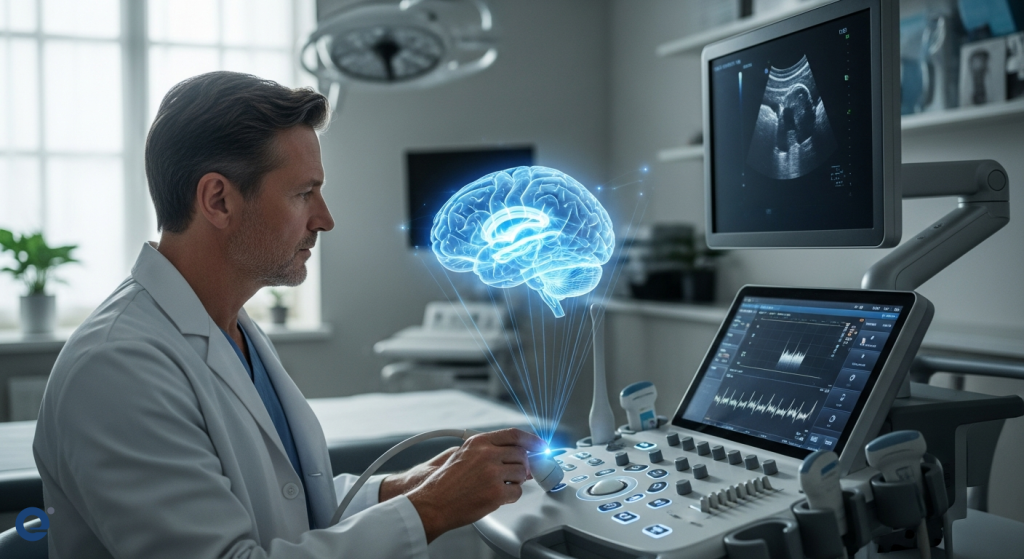
High-frequency ultrasound beams are concentrated. They converge at a specific point deep within the brain. This convergence generates localized heat. This intense heat causes cell death. It effectively creates a small lesion. Importantly, this lesioning is highly precise. It minimizes damage to surrounding healthy tissue. This is a major advantage over older methods.
Monitoring with MRI
Magnetic Resonance Imaging (MRI) is crucial. It provides real-time visualization. Doctors can see the target area clearly. They can also monitor the temperature rise. This ensures the treatment is delivered accurately. It also helps to avoid overheating healthy areas. This image-guided approach enhances safety significantly.
Current Applications in Movement Disorders
Focused ultrasound has already made a mark. It is particularly promising for movement disorders. These include conditions like essential tremor and Parkinson’s disease (PD). Traditionally, these were managed with medications or invasive surgery.
Essential Tremor Treatment
For essential tremor, FUS is a game-changer. It offers a less invasive alternative to surgery. In July 2016, the FDA approved the Exablate Neuro system. This MRI-guided FUS device treats essential tremor. It is for patients who don’t respond to medication. The procedure involves shaving the head. A stereotactic frame is then placed. This is done under local anesthesia. The FUS treatment itself takes about three hours in the MRI scanner. Patients can often go home the same or next day. This rapid recovery is a major benefit. It provides an effective option with fewer risks than traditional surgery.
Nir Lipsman, MD, PhD, of Sunnybrook Research Institute, notes its effectiveness. He states that FUS for essential tremor is well tolerated. Patients are often eager to explore eligibility. This highlights the growing interest in non-invasive options.
Parkinson’s Disease (PD) Therapy
While FUS for essential tremor is a standard of care, its application in PD is still developing. It is currently in experimental stages. Phase 1 trials are focused on establishing its safety profile. Researchers are paving the way for larger, later-phase trials. The goal is to determine its full potential for PD patients.
Limitations of Traditional Treatments
To appreciate FUS, it’s essential to understand the limitations of older methods. Traditional surgeries and even other non-invasive techniques have drawbacks.
Deep Brain Stimulation (DBS)
Deep brain stimulation (DBS) is a common surgical approach for PD. It involves implanting electrodes in the brain. These electrodes deliver electrical impulses. However, DBS has significant limitations. There are risks associated with device implantation. The electrical stimulation itself can have side effects. Furthermore, DBS has high maintenance costs. It requires continuous follow-up care. This makes it unsuitable for some patients. For instance, immunocompromised individuals may not be good candidates. Those who find regular follow-up difficult also face challenges.
Radiofrequency Lesioning
Lesioning procedures can be an alternative. However, radiofrequency techniques have their own risks. A major concern is the lack of precise control over lesion size. This can lead to irreversible adverse effects. FUS offers a much higher degree of control.
Beyond Ablation: New Frontiers for FUS
The potential of focused ultrasound extends far beyond creating lesions. Researchers are exploring innovative applications. These are in various stages of development, from early research to clinical trials.
Opening the Blood-Brain Barrier (BBB)
A significant area of research involves low-frequency ultrasound. This frequency range can temporarily open the blood-brain barrier (BBB). The BBB is a protective layer that prevents many substances from entering the brain. By opening it, FUS can facilitate drug delivery. This allows therapeutic agents to reach specific brain regions more effectively. This application is currently under clinical investigation and is not yet FDA-approved. However, it holds immense promise for treating brain diseases. Tim Meakem, MD, chief medical officer of the Focused Ultrasound Foundation, highlighted this. He stated that FUS-facilitated therapeutic delivery is a promising area. Strong preclinical evidence is now being translated to the clinic.
This enhanced drug delivery could revolutionize treatment for many neurological conditions. It offers a targeted approach. This minimizes systemic side effects. It could be particularly beneficial for diseases like brain tumors and epilepsy.
Neuromodulation and Immunomodulation
Other exciting research areas include neuromodulation and immunomodulation. These techniques aim to influence nerve activity and the immune system, respectively. More research is needed to fully understand these biomechanisms. However, they could offer novel tools for treating conditions like Parkinson’s disease. These approaches represent a shift towards more sophisticated, less destructive interventions.
FUS Applications Beyond Movement Disorders
The versatility of FUS means its impact is not limited to movement disorders. It is being investigated for a wide range of other neurological conditions.
Epilepsy Treatment
FUS-mediated thermal ablation is being evaluated for epilepsy. The goal is to precisely target and ablate epileptogenic foci. These are the brain regions where seizures originate. FUS can also potentially disrupt abnormal brain networks associated with epilepsy. Preclinical studies are also exploring nonthermal ablation techniques. These use FUS at lower frequencies, around 250 KHz. This broadens the therapeutic possibilities for epilepsy management.
Brain Tumors
Similarly, FUS shows promise for treating brain tumors. This method may be particularly effective for deeply located tumors. Traditional surgical removal can be challenging for such lesions. FUS offers a non-invasive way to target and destroy tumor cells. Research is ongoing to optimize its use in oncology.
The Broader Landscape: Innovations in Minimally Invasive Surgery
Focused ultrasound is a leading example, but it’s part of a larger trend. The future of surgery is undeniably moving towards less invasive approaches. This benefits patients in numerous ways.
Advantages for Patients
Minimally invasive surgery offers several key advantages. These include:
- Reduced pain and discomfort.
- Shorter hospital stays.
- Faster recovery times.
- Smaller or no visible scars.
- Lower risk of infection.
- Reduced blood loss.
These benefits translate to a better overall patient experience. They also reduce the burden on healthcare systems.
Technological Advancements
Beyond FUS, other technologies are contributing to this shift. Advances in robotics, endoscopy, and imaging are all playing a role. These innovations allow surgeons to perform complex procedures with greater precision and minimal disruption. The focus is on achieving the same or better outcomes as traditional surgery, but with less trauma to the body.
The Future Outlook
The trajectory is clear: non-invasive and minimally invasive techniques will become increasingly dominant. Focused ultrasound is at the forefront of this revolution. Its ability to target deep tissues precisely without incisions is remarkable. As research progresses, we can expect FUS to be applied to an even wider array of conditions. This includes neurological disorders, cancer, and potentially other diseases.
Surgical innovators are driving these advancements. They are constantly pushing the boundaries of what’s possible. Their work promises a future where surgery is safer, more effective, and less burdensome for patients.
Inside the Future of Functional Neurosurgery with Professor Ludvic Zrinzo
Frequently Asked Questions (FAQ)
What is the main difference between focused ultrasound and traditional surgery?
The main difference is that focused ultrasound is non-invasive. It uses ultrasound waves to treat tissue without making any incisions. Traditional surgery typically involves cutting into the body.
Is focused ultrasound painful?
Focused ultrasound procedures are generally well-tolerated. They are often performed under local anesthesia. While patients may feel some sensation, significant pain is usually managed effectively.
What are the potential risks of focused ultrasound?
As with any medical procedure, there are potential risks. These can include temporary side effects like swelling or discomfort. The precise nature of FUS helps to minimize risks to surrounding healthy tissue. However, specific risks depend on the treatment area and individual patient factors.
When will focused ultrasound be widely available for more conditions?
The availability of focused ultrasound for various conditions is rapidly expanding. While it is already a standard of care for essential tremor, research is ongoing for many other applications. Clinical trials and regulatory approvals will determine wider availability.
How does focused ultrasound compare to deep brain stimulation (DBS)?
Focused ultrasound offers a non-invasive alternative to DBS for certain conditions. DBS requires surgical implantation of a device, carrying risks and higher maintenance costs. FUS, in contrast, avoids implants and is performed in a single session for many applications.
