
Deforestation’s Toll: How Forests Shape Our Water Cycle
Published on December 31, 2025 by Admin
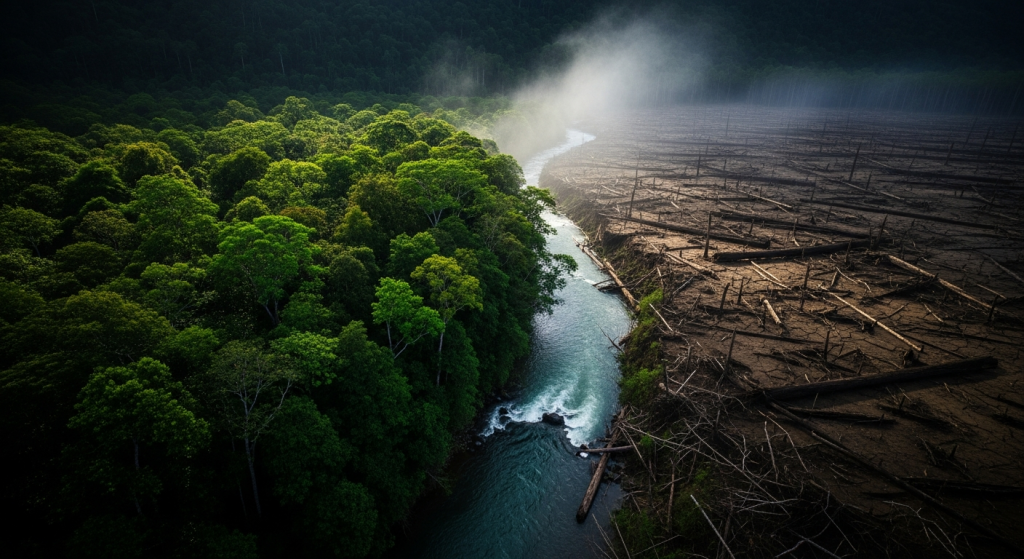
The world’s forests are more than just beautiful landscapes. They are vital regulators of our planet’s water cycle. However, widespread deforestation is severely disrupting this essential natural process. This disruption has far-reaching consequences for ecosystems and human societies alike. Understanding these impacts is crucial for informed environmental policy and sustainable land management.
The Indispensable Role of Forests in the Water Cycle
The water cycle, also known as the hydrological cycle, describes the continuous movement of water between Earth’s surface and atmosphere. It involves evaporation, condensation, precipitation, infiltration, runoff, and transpiration. This cycle is fundamental for supplying freshwater to all living organisms and regulating global weather patterns. Only about 3% of all water on Earth is freshwater, making its circulation and purification by the water cycle incredibly important.
Trees play a particularly critical role in this cycle. Through their roots, they absorb water from the soil. Then, they release this water vapor into the atmosphere through their leaves in a process called transpiration. This added moisture in the air is essential for cloud formation, which ultimately leads to rainfall. Therefore, forests act as massive water reservoirs, directly influencing precipitation patterns. Transpiration also has a cooling effect on the surrounding air, much like human perspiration cools our bodies.

Transpiration: A Forest’s Contribution to Rainfall
Every single tree acts as a fountain. It draws water from the ground and releases it as vapor. When billions of trees are concentrated in a forest, they create vast “rivers in the sky.” These aerial rivers are crucial for forming clouds and generating rainfall, often thousands of miles away. In large forest areas like the Amazon, transpiration is a significant source of local and regional rainfall. For instance, it is estimated that around 20% of the Amazon’s rainfall has transpired at least once within the basin itself.
The water vapor released by trees cools the air. This cooling effect is substantial. A single tree can transpire hundreds of liters of water daily. This amount of moisture release can have a cooling effect equivalent to two domestic air conditioners running for a day. This arboreal air conditioning is vital for moderating local and regional climates.
How Deforestation Disrupts the Water Cycle
When forests are cleared, the intricate balance of the water cycle is thrown into disarray. The removal of trees directly impacts several key processes. These impacts can be felt locally, regionally, and even globally.
Decreased Transpiration and Evaporation
As more trees are cut down, the process of transpiration is significantly reduced. This means less water vapor enters the atmosphere. Consequently, there is less moisture available for cloud formation and subsequent rainfall. This leads to drier air, lower humidity, and a decrease in precipitation. The overall result is a disruption in the natural flow of water, often leading to drought-prone conditions.
Deforestation also affects evaporation levels. Without the canopy cover provided by trees, the soil is more exposed to direct sunlight. This can lead to increased evaporation from the soil surface, but it doesn’t compensate for the loss of transpiration. Instead, it contributes to a net drying effect.
Impacts on Infiltration and Runoff
Forests play a crucial role in managing rainwater. Tree leaves and roots act like a natural sponge. They absorb rainwater, promoting infiltration into the soil. This process replenishes groundwater reserves. It also reduces the amount of water that flows over the land surface as runoff.
However, deforestation reverses this effect. Without trees, there is nothing to hold the soil cover. Rainwater hits the bare ground with greater force. This leads to significantly decreased infiltration. Instead, water rapidly runs off the surface. This increased runoff carries away topsoil, leading to soil erosion. Furthermore, it can sweep pollutants into nearby rivers and water reservoirs. This process contributes to more frequent flooding and degrades water quality.
Regional and Global Consequences of Water Cycle Disruption
The consequences of deforestation on the water cycle extend far beyond the immediate cleared areas. The interconnectedness of global climate systems means that the loss of forests in one region can have profound effects elsewhere.
“Rivers in the Sky” and Distant Rainfall
The concept of “rivers in the sky” highlights how moisture generated by forests travels vast distances. For example, the Amazon rainforest produces immense amounts of water vapor daily. This vapor travels across the Western Hemisphere. It is a critical source of rainfall for agricultural breadbaskets in regions like Paraguay, Uruguay, and northern Argentina. Even the farms in the American Midwest rely on rainfall that originated from tropical forests in the Amazon. It’s estimated that nearly 50% of rainfall in the Midwest originates from inland transpiration.
Similarly, deforestation in West Africa can deplete rainfall over the Ethiopian highlands, impacting the Nile River. Deforestation in China can dry up its own lands and affect areas in Eastern Europe and Southeast Asia. These examples illustrate how crucial intact forests are for maintaining predictable rainfall patterns for agriculture and water supply in numerous regions worldwide.
Increased Vulnerability to Droughts and Floods
The disruption of the water cycle due to deforestation makes regions more vulnerable to extreme weather events. Reduced rainfall and lower soil moisture lead to increased instances and severity of droughts. Conversely, the increased surface runoff from deforested areas can exacerbate flooding during heavy rain events. This creates a dangerous cycle of water scarcity and inundation.
The Amazon, for instance, has lost around 20% of its forest cover in the last 50 years. If current trends continue, it is predicted to reach an irreversible tipping point by 2050. This could lead to rapid ecosystem collapse and devastating changes in regional rainfall patterns. São Paulo, Brazil, has already experienced severe droughts directly linked to deforestation in the Amazon.
Beyond Carbon: Non-Carbon Impacts of Deforestation
While the role of forests in absorbing carbon dioxide and mitigating climate change is well-known, their “non-carbon” impacts are equally significant. These include the direct influence on water cycles and local temperature regulation.
Local Temperature Regulation and Urban Heat Islands
Forests act as natural climate moderators. They keep their local environments cooler through shading and transpiration. As mentioned, transpiration cools the air by releasing moisture. When forests are removed, this “arboreal air conditioning” is lost. This leads to higher local temperatures.
In deforested areas, especially those being converted to agriculture or urban development, surface temperatures can increase significantly. Studies in Sumatra, for example, have shown temperature increases of over 1 degree Celsius in logged areas compared to forested ones. In some parts of Sumatra, temperature differences between forest and clear-cut land can reach up to 10 degrees Celsius. This contributes to the urban heat island effect in nearby cities, making them hotter and more prone to heatwaves.
Impacts on Biodiversity and Ecosystem Services
Deforestation causes a drastic loss of biodiversity. Forests are home to 80% of land-based plant and animal species. When forests are cleared, these species lose their habitats, leading to population declines and extinctions. This loss weakens essential ecosystem services, such as clean air, water purification, and soil health. Each species plays a role in maintaining ecological balance. Their disappearance can have cascading effects throughout the food web.
For example, pollinator populations decline when forests are destroyed. This directly impacts crop yields and food security. The intricate dance between pollinators and plants is essential for both natural ecosystems and human agriculture. Understanding this interconnectedness highlights the broader environmental damage caused by deforestation.
Addressing Deforestation for Water Security and Climate Stability
Mitigating the impacts of deforestation requires a multi-faceted approach. It involves conservation, reforestation, and sustainable land-use practices.
Conservation and Reforestation Efforts
Protecting existing forests is paramount. Efforts like EARTHDAY.ORG’s Canopy Project focus on planting trees to restore degraded areas. These initiatives help manage biodiversity, reduce atmospheric carbon, and rebalance the hydrological cycle. Rehabilitating deforested areas, such as in Cape Town, South Africa, by planting trees can help restore climate patterns, increase rainfall, and preserve local water resources.
Sustainable forestry practices are also crucial. These practices aim to balance timber production with ecological preservation. They ensure that forests can continue to provide essential ecosystem services while also meeting human needs. Exploring links to articles on sustainable forestry can provide deeper insights into these methods.
Policy and Land-Use Planning
Effective environmental policies are essential to combat illegal deforestation and promote responsible land use. Governments must enforce laws protecting forests and ensure that land clearing for agriculture, cattle ranching, or development is managed sustainably. International cooperation is also vital, given the global nature of forest ecosystems and their impact on climate and water cycles.
Policy makers need to consider the hydrological impacts of deforestation. This includes assessing the water requirements of different land-use practices. Promoting practices like regenerative agriculture can help heal the land and ensure long-term food security without further degrading vital forest ecosystems. Further reading on regenerative agriculture offers a path towards more sustainable land management.
Frequently Asked Questions (FAQ)
What is the primary way forests regulate the water cycle?
Forests primarily regulate the water cycle through transpiration, where trees release water vapor into the atmosphere, contributing to cloud formation and rainfall. They also facilitate infiltration of rainwater into the soil and reduce surface runoff.
How does deforestation lead to droughts?
Deforestation reduces transpiration, meaning less water vapor enters the atmosphere. This leads to lower humidity, decreased cloud formation, and reduced rainfall, which can result in drought conditions over time.
Can deforestation in one region affect rainfall in another continent?
Yes, absolutely. Moisture generated by large forests like the Amazon can travel thousands of miles, influencing rainfall patterns in distant regions, even on other continents, through atmospheric moisture transport.
What are the non-carbon impacts of deforestation on the climate?
Besides releasing stored carbon, deforestation significantly impacts local and regional climates by reducing transpiration’s cooling effect and altering rainfall patterns. This can lead to increased local temperatures and more extreme weather events like droughts and floods.
How does deforestation affect soil and water quality?
Without tree cover, soil erosion increases due to higher runoff. This eroded soil and associated pollutants can enter waterways, degrading water quality and increasing the risk of flooding.
Conclusion
The relationship between forests and the water cycle is undeniable and critical for life on Earth. Deforestation, driven by various human activities, poses a severe threat to this delicate balance. The disruption of transpiration, infiltration, and runoff leads to altered rainfall patterns, increased droughts and floods, and localized temperature increases. These impacts are not confined to local areas but ripple across continents, affecting agriculture, water security, and biodiversity.
For hydrologists and environmental policy makers, understanding and addressing the water cycle disruption caused by deforestation is paramount. Investing in forest conservation, promoting reforestation, and implementing sustainable land-use policies are essential steps. By safeguarding our forests, we safeguard our planet’s most vital resource: water. This ensures a more stable climate and a healthier future for all living beings.
