
AI in Personalized Healthcare: Precision from Genes to Treatments
Published on January 12, 2026 by Admin
The Dawn of a New Healthcare Era
Healthcare is changing rapidly. Artificial intelligence (AI) is at the forefront of this revolution. It is transforming how we understand and treat diseases. This new era focuses on personalization. Every patient is unique. Therefore, their treatment should be too.
AI helps unlock this potential. It analyzes vast amounts of data. This data comes from many sources. It includes genetics, lifestyle, and medical history. As a result, AI offers insights never before possible.
Unlocking the Genetic Code with AI
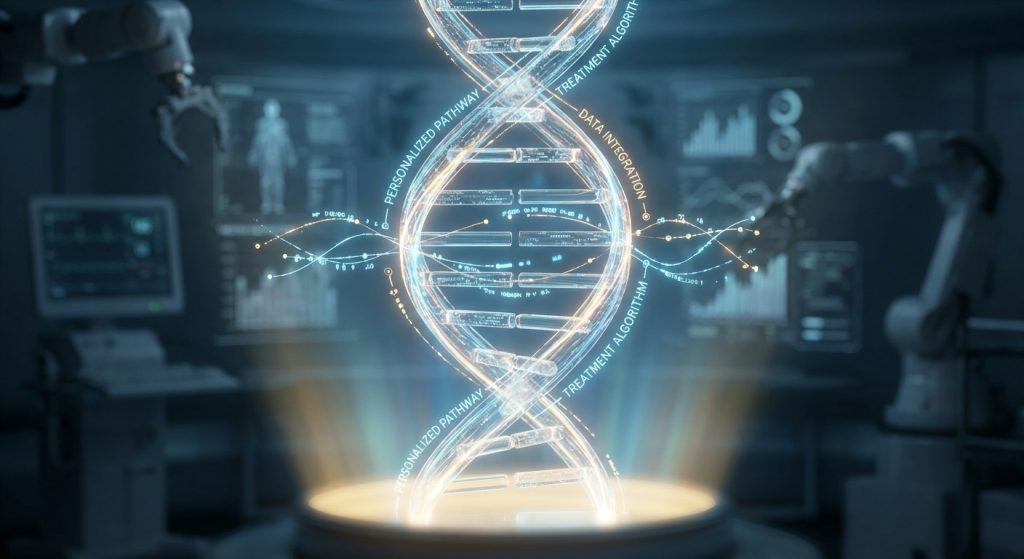
Genetics is key to personalized medicine. Our DNA holds the instructions for our bodies. Variations in these instructions can lead to diseases. AI can now map and understand these variations. This process is called genetic mapping.
Machine learning algorithms excel at this. They can identify subtle patterns. These patterns are often missed by human analysis. AI can predict disease risks. It can also identify predispositions to certain conditions. This allows for early intervention.
Furthermore, AI helps interpret complex genomic data. This is crucial for understanding rare diseases. It also aids in identifying drug responses. This information guides treatment decisions. For example, AI can predict which drugs will be most effective for a patient. This avoids trial-and-error approaches.
The field of epigenetics is also enhanced by AI. Epigenetics studies how lifestyle and environment affect gene expression. AI can untangle these complex interactions. This offers a more complete picture of health.
AI-Powered Diagnostics: Seeing the Unseen
Accurate diagnosis is the first step in treatment. AI is significantly improving diagnostic capabilities. It can analyze medical images with remarkable speed and accuracy. This includes X-rays, CT scans, and MRIs.
AI algorithms can detect anomalies. They can spot early signs of cancer. They can also identify signs of diabetic retinopathy. This is often before they are visible to the human eye. Consequently, diagnoses are faster and more precise.
Moreover, AI is revolutionizing pathology. It can analyze tissue samples. This helps identify cancerous cells. It also grades their aggressiveness. This assists pathologists in making critical decisions. The use of AI in diagnostics can reduce errors. It also speeds up the diagnostic process. This is vital for patient outcomes.
Liquid biopsies are another area where AI shines. These tests analyze blood for cancer markers. AI helps interpret the complex data from these tests. This offers a less invasive way to detect and monitor cancer. You can learn more about liquid biopsies and early cancer detection in our related article.
Precision Treatment: Tailoring Therapies
Once a diagnosis is made, treatment begins. AI ensures treatments are personalized. It considers a patient’s unique genetic makeup. It also factors in their lifestyle and environment.
For instance, in oncology, AI can predict treatment response. It analyzes tumor genetics. It also looks at patient data. This helps select the most effective chemotherapy or immunotherapy. This approach minimizes side effects. It also maximizes treatment success.
AI also aids in drug discovery and development. It can sift through millions of compounds. It identifies potential drug candidates faster. This speeds up the creation of new medicines. It also helps repurpose existing drugs for new uses.
Furthermore, AI can optimize treatment plans. It can adjust dosages. It can also schedule interventions based on real-time patient data. This dynamic approach ensures continuous care improvement. This is a significant leap from one-size-fits-all methods.
AI in Drug Discovery and Development
The traditional drug discovery process is long and costly. AI dramatically accelerates this. It uses complex algorithms to analyze vast biological datasets. This includes genomic, proteomic, and chemical information.
AI can predict how molecules will interact. It can identify potential drug targets. It can also design new drug molecules. This significantly reduces the time and resources needed. As a result, new therapies reach patients faster.
Moreover, AI helps in clinical trial design. It can identify suitable patient cohorts. It can also predict trial outcomes. This makes trials more efficient. It also increases the likelihood of success. The integration of AI is making drug development more precise and effective.
Predictive Analytics and Proactive Health
AI’s power extends beyond diagnosis and treatment. It can predict future health events. This enables proactive healthcare. Instead of reacting to illness, we can prevent it.
By analyzing patient data, AI can identify individuals at high risk. This risk could be for conditions like heart disease or diabetes. Early identification allows for lifestyle changes. It also permits preventative interventions.
Wearable devices generate a lot of data. This includes heart rate, sleep patterns, and activity levels. AI analyzes this data. It can detect subtle changes. These changes might indicate an impending health issue. For example, an unusual heart rhythm could be flagged. This allows for prompt medical attention.
This predictive power is a game-changer. It shifts the focus from sick care to health care. It empowers individuals to manage their well-being. It also reduces the burden on healthcare systems. The concept of biohacking fundamentals aligns with this proactive approach.
Challenges and Ethical Considerations
Despite its immense potential, AI in healthcare faces challenges. Data privacy is a major concern. Sensitive patient information must be protected. Robust security measures are essential.
Algorithmic bias is another critical issue. If AI is trained on biased data, its predictions can be unfair. This could lead to disparities in care. Ensuring fairness and equity in AI algorithms is paramount.
Furthermore, regulatory frameworks are still evolving. Clear guidelines are needed for AI deployment. This ensures patient safety and trust. The integration of AI requires careful consideration. It must be done responsibly.
Physician adoption is also key. Clinicians need to trust AI tools. They must understand how AI complements their expertise. Education and training are vital. The goal is collaboration, not replacement. This collaborative approach ensures the best patient outcomes.
The Future of AI in Healthcare
The future of AI in healthcare is bright. We can expect even more sophisticated applications. AI will continue to drive personalization. It will make healthcare more accessible and efficient.
Imagine AI assistants helping manage chronic conditions. Consider AI predicting epidemic outbreaks. Think about AI personalizing mental health interventions. These are not distant dreams. They are becoming reality.
AI will undoubtedly reshape the physician’s role. It will free up their time. This allows for more meaningful patient interaction. AI engineers will play a crucial role in developing these tools. Health optimization enthusiasts will leverage these advancements. They will use them to enhance their well-being.
The synergy between AI, genetics, and medicine is powerful. It promises a future of longer, healthier lives. It is a future where healthcare is truly tailored to each individual. This journey is just beginning. The potential for positive impact is enormous.
Frequently Asked Questions (FAQ)
How does AI use genetic mapping for personalized treatment?
AI analyzes an individual’s unique genetic code. It identifies specific gene variations. These variations can influence disease risk and drug response. Based on this, AI helps tailor treatments. This ensures they are most effective for that person. For example, it can predict which medications will work best.
What are the main ethical concerns with AI in healthcare?
Key ethical concerns include data privacy and security. Protecting sensitive patient information is critical. Algorithmic bias is another major issue. If AI models are trained on biased data, they can perpetuate health disparities. Ensuring fairness and transparency is essential.
Can AI replace doctors in the future?
It is unlikely that AI will completely replace doctors. Instead, AI is expected to augment human capabilities. It will handle complex data analysis and repetitive tasks. This allows physicians to focus on patient interaction and complex decision-making. The future is likely a collaborative one.
How does AI contribute to early disease detection?
AI excels at analyzing medical images like X-rays and MRIs. It can detect subtle anomalies indicative of disease. This often happens earlier than human detection. AI also analyzes data from liquid biopsies. This aids in identifying cancer markers at very early stages.
What is the role of AI in drug discovery?
AI significantly speeds up drug discovery. It analyzes vast biological and chemical datasets. This helps identify potential drug targets and design new drug molecules. Furthermore, AI can optimize clinical trial design. This makes the process more efficient and successful.
