Water Sovereignty: Advanced Desalination & Atmospheric Harvesting
Published on January 13, 2026 by Admin

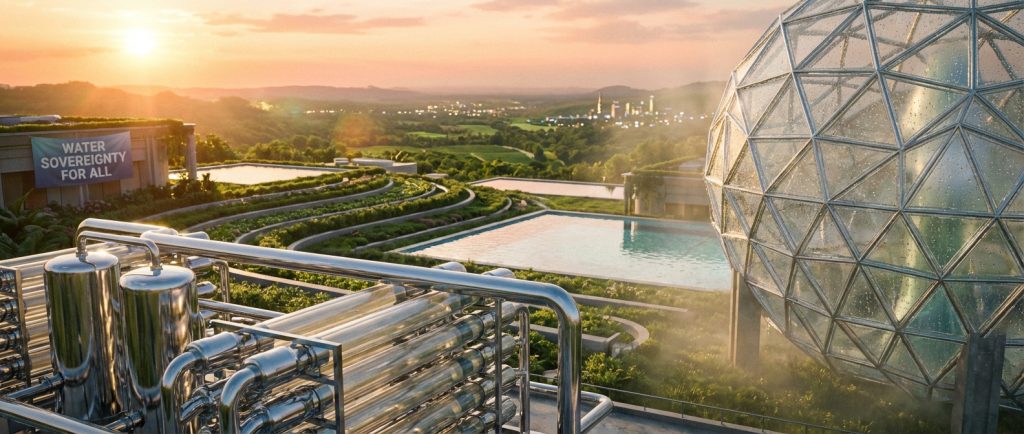
Water is life. Yet, many regions worldwide face severe water scarcity. This crisis impacts everything from daily survival to economic stability. Fortunately, innovative technologies are emerging. Advanced desalination and atmospheric water harvesting offer new hope. These solutions aim to secure water sovereignty for communities. They provide reliable access to freshwater, even in arid environments. This article explores these groundbreaking technologies. We will discuss their potential for infrastructure planners, hydrologists, and residents in water-stressed areas.
The Growing Global Water Challenge
The global water ecosystem is valued at a staggering $58 trillion. This value is equivalent to 60% of the world’s GDP. However, this vital resource is under immense pressure. Freshwater demand is projected to exceed supply by 40% by 2030. This deficit poses a significant threat to human well-being and planetary health. Households use 11% of global water. Industries use 19%. Agriculture consumes a massive 70%. Without adequate water, we face challenges in drinking water, sanitation, food production, and energy generation. Furthermore, ecosystems and biodiversity are severely impacted. Since 1970, freshwater wildlife populations have dropped by 83%. Many river basins are projected to remain unhealthy.
In the European Union, for instance, 90% of studied river basins are expected to be unhealthy by 2027. This situation is critical, especially for communities already struggling with limited water resources. The consequences of water scarcity are far-reaching. They include increased competition for resources, displacement of populations, and potential conflict. Therefore, developing sustainable and resilient water solutions is paramount. These solutions must address both immediate needs and long-term security.
Advanced Desalination: Turning Saltwater into Freshwater
Desalination is a critical technology for regions with access to seawater but lacking freshwater. It involves removing salt and other minerals from saline water. This process creates potable water. Historically, desalination was energy-intensive and expensive. However, advancements have significantly improved efficiency and reduced costs. Reverse Osmosis (RO) is a leading desalination technology. It uses semi-permeable membranes to separate salt from water under pressure. New membrane materials and energy recovery systems are making RO more viable than ever before. For example, companies like Active Membrane, Inc. are developing advanced membranes for desalination applications. They are seeking investors for their innovative solutions.
Furthermore, emerging technologies like Forward Osmosis and Membrane Distillation offer alternative approaches. These methods can be more energy-efficient in certain contexts. They may also be better suited for treating brackish water. The goal is to produce clean water with minimal environmental impact. For instance, ChilCorp Inc. is advancing membrane-free, solid-state desalination using its “Water Cubes” technology. This approach aims for ultra-low energy consumption and reduced costs. They are looking for strategic investors and pilot-site collaborators.
Challenges and Opportunities in Desalination
Despite progress, desalination still faces challenges. One major concern is the disposal of brine, the concentrated saltwater byproduct. Improper disposal can harm marine ecosystems. Therefore, innovative brine management strategies are crucial. These include brine concentration, salt recovery, and zero-liquid discharge systems. Another challenge is the energy required for the process. While improving, desalination still consumes significant energy. Integrating renewable energy sources like solar and wind power can mitigate this. This integration makes desalination more sustainable and cost-effective. Ultimately, desalination provides a vital buffer against freshwater shortages, especially for coastal communities.
Atmospheric Water Harvesting: Capturing Water from Air
Atmospheric Water Generation (AWG), or water harvesting, offers a decentralized solution. It extracts water vapor directly from the air. This technology is particularly promising for inland arid regions. It doesn’t rely on proximity to the ocean. AWG systems can operate off-grid. Many use passive or solar-powered designs. They exploit principles of water osmosis or condensation. Source Global, for example, has seen significant success with its atmospheric water generators. The company raised $130 million from Breakthrough Energy Ventures. This investment highlights the growing interest and potential of AWG technology.
AirJoule is another innovator in this space. They focus on decentralized atmospheric water production. Their technology works across a broad range of temperatures and humidity levels. It can also convert industrial low-grade waste heat into water. AirJoule is actively seeking deployment partners and investors. This technology offers a flexible and scalable approach to water generation. It can be deployed in various settings, from individual homes to larger community needs.
How Atmospheric Water Harvesting Works
AWG devices typically employ materials that can absorb moisture from the air. These materials are then heated, releasing the captured water vapor. This vapor is condensed into liquid water. Some systems use desiccants that absorb water. Others use cooling mechanisms to reach the dew point. The efficiency of these systems depends on ambient temperature and humidity. Therefore, optimizing designs for different climates is essential. MIT has also developed a compact device that extracts clean water from desert air. This invention offers a revolutionary solution for severe water scarcity.
The potential for AWG is immense. It can provide clean drinking water to remote communities. It can also supplement existing water sources during droughts. Furthermore, it reduces the reliance on large-scale infrastructure. This decentralized approach enhances water security and resilience. For hydrologists, understanding air moisture dynamics becomes increasingly important. For infrastructure planners, integrating AWG into water management strategies is a key consideration.
Integrating Advanced Technologies into Water Management
Securing water sovereignty requires a multi-faceted approach. Advanced desalination and atmospheric water harvesting are powerful tools. However, they must be integrated with existing water management frameworks. In Florida, for example, Chapter 373 of the Florida Statutes governs water resources. It outlines policies for water management districts, permitting of consumptive uses, and alternative water supply development. This legislation emphasizes the state’s commitment to managing and conserving its water resources. Such legal and policy frameworks are essential for the successful implementation of new water technologies.
Water management districts play a crucial role. They are responsible for developing water plans and implementing strategies. This includes identifying areas with water use caution and developing recovery strategies. Pilot programs for alternative water supply development are also vital. These programs test and refine new technologies like desalination and AWG. Collaboration between districts, state agencies, and private entities is key. This collaboration ensures that these advanced solutions are deployed effectively and sustainably.
The Role of Water Tech Innovation
The water tech sector is experiencing rapid growth. In 2023, water tech companies received $1.2 billion in funding. This indicates strong investor confidence in the sector’s potential. Water treatment companies, including those in wastewater treatment, have attracted significant investment. Wastewater treatment is crucial for resource recovery and environmental protection. Most wastewater is currently discharged untreated, impacting ecosystems. Companies are developing hardware and software solutions for efficient water purification. The water startup ecosystem is valued at over $25 billion, with a significant portion stemming from companies founded since 2010.
Innovation extends beyond treatment. Companies are also focusing on smart water management systems. These systems use data analytics and AI to optimize water distribution and usage. For instance, AIxxlnt is developing a software platform for water utilities to manage data for AI analysis. They are seeking $500K – $1M in pre-seed funding. Such technologies are essential for building resilient and efficient water infrastructure. They enable better decision-making and resource allocation. This innovation is crucial for achieving water sovereignty.
Ensuring Water Sovereignty for the Future
Water sovereignty means having control over one’s water resources. It ensures access to safe, sufficient, and culturally appropriate water. Advanced desalination and atmospheric water harvesting are key enablers. They offer pathways to independence from unreliable traditional sources. For infrastructure planners, this means investing in diversified water portfolios. For hydrologists, it means understanding the full spectrum of water availability, including atmospheric moisture. For residents, it means advocating for and benefiting from these new solutions.
The integration of these technologies requires careful planning. It involves assessing local needs, environmental conditions, and economic feasibility. Public education and community engagement are also vital. Residents must understand the benefits and limitations of these technologies. This ensures buy-in and responsible management. Ultimately, achieving water sovereignty through innovation is about building a secure and sustainable water future for all.
Frequently Asked Questions
What is water sovereignty?
Water sovereignty refers to the right and ability of a community or region to control its own water resources. This includes managing water for its own needs, ensuring equitable access, and protecting water sources from depletion or pollution.
How does advanced desalination work?
Advanced desalination, primarily Reverse Osmosis (RO), uses high pressure to force saline water through semi-permeable membranes. These membranes allow water molecules to pass but block salt and other impurities, producing freshwater.
What are the main challenges with desalination?
The main challenges include the high energy consumption required for the process and the disposal of brine, the concentrated saltwater byproduct, which can harm marine ecosystems if not managed properly.
How does atmospheric water harvesting work?
Atmospheric water harvesting (AWG) devices extract water vapor from the air. They typically use materials that absorb moisture, which is then released and condensed into liquid water, often powered by solar energy or ambient temperature differences.
Are atmospheric water generators efficient in all climates?
The efficiency of AWG systems is dependent on ambient temperature and humidity. They are generally more effective in humid environments, but advancements are being made to improve performance in drier conditions.
What role do government regulations play in adopting new water technologies?
Government regulations, like Florida’s Chapter 373, provide the legal framework for water management. They guide permitting, resource allocation, and the development of alternative water supplies, which is crucial for integrating technologies like desalination and AWG.