High Throughput Screening: Accelerating Discovery
Published on January 21, 2026 by Admin

In the fast-paced world of research and development, speed is crucial. Discovering new drugs, materials, and solutions requires sifting through countless possibilities. High Throughput Screening (HTS) technology is a game-changer. It allows researchers to test thousands, even millions, of compounds quickly. This dramatically speeds up the discovery process. Therefore, HTS is an indispensable tool for modern R&D.
What is High Throughput Screening?
High Throughput Screening, or HTS, is a method used in drug discovery and research. It involves automated systems. These systems can test a large number of chemical or biological samples. The goal is to identify active compounds. These compounds might be potential drug candidates or have other valuable properties. HTS is essential for finding needles in a haystack. It makes the search efficient and systematic.
The Core Principle of HTS
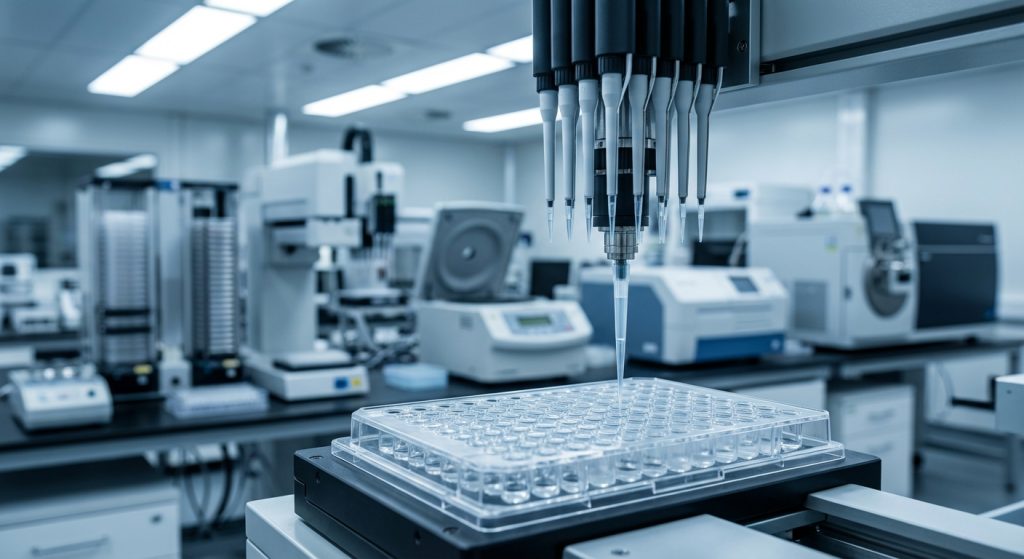
The fundamental idea behind HTS is parallelism. Instead of testing one compound at a time, HTS tests many simultaneously. This is typically done using microplates. These plates have many small wells. Each well can hold a tiny sample. Automated robots then add reagents and perform assays. As a result, vast numbers of tests can be run in a short period. This efficiency is its main advantage.
Key Components of HTS Technology
Several integrated technologies make HTS possible. These components work together seamlessly. Understanding these parts helps appreciate the complexity and power of HTS.
1. Automation and Robotics
Automation is the backbone of HTS. Robotic systems handle tasks like liquid handling, plate movement, and reagent addition. These robots are highly precise. They ensure consistency across thousands of tests. This reduces human error significantly. Furthermore, automation allows for continuous operation, maximizing screening capacity. For example, automated liquid handlers can dispense nanoliters of liquid with great accuracy.
2. Assay Development
A robust assay is critical for HTS. The assay is the test performed on each sample. It must be sensitive, specific, and adaptable to automation. Assays can be biochemical, cellular, or even whole-organism based. They are designed to detect a specific biological or chemical effect. Thus, a well-designed assay is key to successful screening.
3. Data Acquisition and Analysis
HTS generates enormous amounts of data. Sophisticated instruments are needed to read the results from each well. This data then needs to be processed and analyzed. Specialized software is used to identify hits. Hits are compounds that show the desired activity. Therefore, data management and analysis are as important as the screening itself.
4. Microplate Technology
Microplates are the standard format for HTS. They come in various formats, such as 96-, 384-, and 1536-well plates. These plates allow for miniaturization. This reduces reagent consumption and costs. The small volume also allows for faster reaction times. Consequently, microplates are fundamental to the efficiency of HTS.
Applications of High Throughput Screening
HTS is not limited to drug discovery. Its applications span various scientific fields. It accelerates research and development across industries.
Drug Discovery and Development
This is the most well-known application. HTS is used to identify lead compounds for new drugs. Researchers screen large libraries of chemical compounds against a specific biological target. This target might be an enzyme, receptor, or protein involved in a disease. By identifying compounds that interact with the target, they can begin drug development. This process is crucial for finding new treatments for diseases. It is also important for tackling challenges like antibiotic resistance.
Genomics and Proteomics Research
HTS helps in understanding complex biological systems. It can be used to identify genes or proteins involved in specific cellular processes. For instance, researchers might screen for compounds that affect gene expression. This provides insights into cellular function. It also aids in understanding disease mechanisms. Furthermore, it can help identify biomarkers for diagnostics.
Agrochemicals and Crop Science
In agriculture, HTS is used to discover new pesticides, herbicides, and fertilizers. Researchers screen compounds for their effects on pests or crops. This helps in developing more effective and environmentally friendly agricultural products. For example, it can identify compounds that enhance crop yield or resist disease. This is vital for global food security.
Materials Science
HTS can also be applied to the discovery of new materials. Researchers can screen compounds for desired properties, such as conductivity, strength, or catalytic activity. This accelerates the development of novel materials for various applications. For instance, it can be used in finding new catalysts for industrial processes.
Advantages of Using HTS
The benefits of implementing HTS are substantial. They directly impact the efficiency and success rate of R&D projects.
- Speed and Efficiency: HTS dramatically reduces the time needed to screen large compound libraries. This accelerates the pace of discovery.
- Cost-Effectiveness: While initial setup costs can be high, HTS significantly reduces the cost per sample tested. Miniaturization also lowers reagent expenses.
- Discovery of Novel Compounds: HTS can uncover unexpected hits. These might lead to entirely new classes of drugs or materials.
- Reduced Human Error: Automation ensures reproducibility and accuracy. This leads to more reliable results.
- Data Generation: HTS generates large datasets. These can be valuable for further analysis and understanding of biological systems.
Challenges and Future Trends in HTS
Despite its advantages, HTS faces challenges. The field is also constantly evolving with new technologies.
Challenges
- High Initial Investment: Setting up an HTS facility requires significant capital for equipment and infrastructure.
- Data Overload: Managing and analyzing the vast amounts of data generated can be complex.
- False Positives and Negatives: Assays are not always perfect. Researchers must validate hits carefully.
- Complexity of Biological Systems: In vitro assays may not always perfectly reflect in vivo biological responses.
Future Trends
The future of HTS is exciting. Several trends are shaping its evolution:
- Artificial Intelligence (AI) and Machine Learning (ML): AI is increasingly used to predict compound activity and optimize screening strategies. This can reduce the number of compounds that need to be physically tested. AI-driven drug discovery is a rapidly growing field.
- Miniaturization and Automation: Technologies continue to push the boundaries of miniaturization. This leads to even smaller assay volumes and higher throughput.
- Phenotypic Screening: Moving beyond target-based screening, phenotypic screening looks at the overall effect of a compound on cells or organisms. This can uncover novel mechanisms of action.
- Organ-on-a-Chip Technology: These microfluidic devices mimic human organs. They offer more physiologically relevant models for screening. This could lead to more accurate predictions of drug efficacy and toxicity.
- Integration with Other Technologies: HTS is being integrated with technologies like genomics, proteomics, and systems biology. This provides a more holistic understanding of biological responses. For example, understanding metagenomics can inform screening targets.
Conclusion
High Throughput Screening is a cornerstone of modern R&D. It has revolutionized the way we discover new drugs, materials, and solutions. By enabling the rapid testing of vast numbers of samples, HTS accelerates innovation. While challenges exist, continuous advancements in automation, AI, and assay design are pushing the boundaries of what’s possible. As a result, HTS will remain a critical technology for R&D executives seeking to drive progress and bring groundbreaking discoveries to market faster.
Frequently Asked Questions (FAQ)
What is the primary goal of High Throughput Screening?
The primary goal of High Throughput Screening is to rapidly identify active compounds from large chemical or biological libraries. These active compounds are often potential candidates for new drugs or possess other valuable properties.
How does HTS reduce costs in research?
HTS reduces costs through miniaturization, which lowers reagent consumption. Automation also decreases the labor required per sample. While the initial setup is expensive, the cost per tested compound is significantly lower than traditional methods.
What are some common types of assays used in HTS?
Common assay types include biochemical assays (e.g., enzyme activity), cellular assays (e.g., cell viability, reporter gene assays), and binding assays. The choice of assay depends on the specific research question and target.
Can HTS be used for non-drug discovery applications?
Yes, HTS is widely used in agrochemicals, materials science, and basic biological research. It helps discover new pesticides, herbicides, catalysts, and understand complex biological pathways.
What is the role of AI in the future of HTS?
AI and machine learning are crucial for predicting compound activity, optimizing screening workflows, analyzing large datasets, and identifying novel targets. This leads to more efficient and targeted screening efforts.
“`